



Let's be honest. You're not opening this text to read dry Wikipedia definitions. If you're reading this article, it means you, as a business owner or manager, are currently facing a very specific and challenging task: how to allocate your marketing budget so that you don't just get mythical "traffic," but actually see real money in the bank.
Perhaps you've been burned before. Perhaps you've paid agencies that promised a golden opportunity in six months, only to see pretty graphs showing rising rankings for search queries no one ever searches. Or, conversely, you've launched ad campaigns yourself, watching in horror as a budget of several hundred dollars vanished in a matter of hours, without generating a single call.
Over fifteen years of working in digital marketing, the KelyanMedia team has seen hundreds of such stories. We've seen search engine algorithms change, empires built on spam technologies collapse, and contextual advertising rates rise, squeezing smaller players out of the market. And today, in 2026, with the advent of generative neural networks and artificial intelligence, the rules of the game have changed so radically that old marketing textbooks can safely be consigned to the trash heap.
In this article, we won't throw around fancy terms just to sound smart. We'll sit down with you at a virtual table and, step by step, break down the anatomy of the two main customer acquisition channels: SEO (search engine optimization) and PPC (pay-per-click advertising). We'll discuss how they work under the hood, the hidden threats they conceal, and, most importantly, how to make them work for your business, not for the enrichment of search engines.
1. The New Search Reality: What Has Artificial Intelligence Changed?
Before we start pitting organic promotion against paid advertising, we need to take a look around and understand the environment we're in. The Google search engine we're all accustomed to is no longer just a directory of blue links. It's become an intelligent conversationalist, and that changes everything.
The introduction of SGE (Search Generative Experience) technology—AI-powered generative search results—has led to search engines automatically answering user questions directly on the search results page. Imagine a person searching for information on how to choose the right motor oil for winter. Previously, they would type in a query, click on your blog article, read it, and then perhaps go to a catalog and buy oil. Today, Google automatically analyzes millions of pages, compiles the ideal answer from them, and returns it to the user. People no longer need to click through to your website. The traffic that many companies have struggled to secure for years is rapidly dwindling.
Does this mean SEO is dead? Absolutely not. It just means it's matured and become much more demanding. Google's artificial intelligence is great at gathering facts, but it lacks human experience. That's why algorithms today, more than ever, demand adherence to the EEAT principles: Experience, Expertise, Authority, and Trustworthiness.
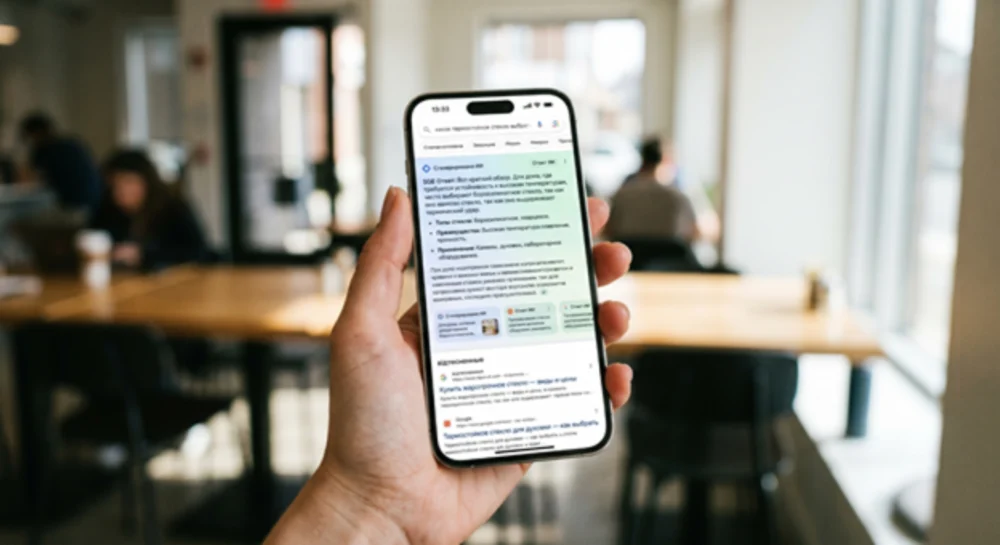
If you're writing an article on behalf of your company, it can't be a bland piece written by a cheap freelance writer for three dollars. Search engines are looking for real experience. They want to see that the text is written by a real professional who has touched the product firsthand, knows its subtle drawbacks, and can offer practical advice. If you sell auto glass repair services or run a chain of barbershops, your content should exude professionalism: photos of actual work, testimonials from real clients, videos of the service process. Only such content can penetrate the defenses of neural networks and generate precious organic traffic.
As for contextual advertising, AI has also made its mark here. Ads are now embedded directly into neural network-generated responses, becoming even more native. Manual bid management is becoming a thing of the past, giving way to fully automated campaigns that decide for themselves who, where, and at what price to show your banner. But the paradox is that the smarter the algorithms become, the higher the cost of error for businesses. Leave a smart campaign unattended and without the right analytics settings, and it will burn through your budget faster than you can pour yourself a cup of coffee.
2. Anatomy of SEO: How to Build Your Company's Digital Asset
Let's talk about search engine optimization as it's commonly discussed in professional circles. Many business owners still think of SEO as a programmer hiding invisible text on a page, filled with keywords like "buy cheap urgent price." Forget that. Today, SEO is a systematic, painstaking engineering process aimed at making your website the best answer to a user's problem in your niche.
When a new client comes to us at KelyanMedia, we explain the essence of SEO using a simple example. Imagine your website is a large supermarket. The Google search engine is a strict inspector coming to inspect you. And users are the buyers.
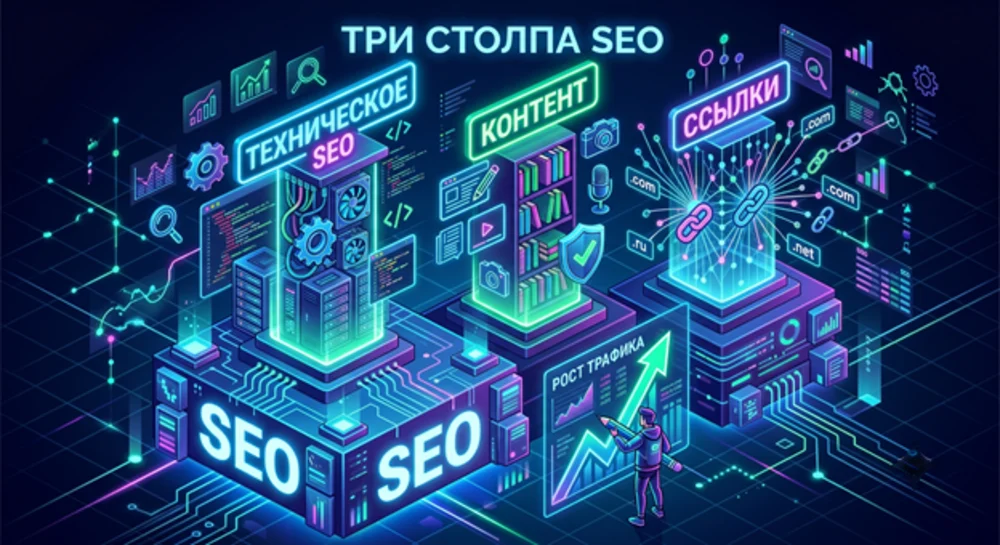
The first stage of work is technical SEO, the foundation of your building. If the supermarket doors don't open, the light bulbs are burned out, and the navigation is so confusing that it's impossible to find bread, the inspector will issue a ticket, and customers will go to the competitor across the street. In the digital world, this means we use programs like Netpeak Spider to crawl the site from top to bottom. We look for broken links (that lead nowhere), duplicate pages (when the same product is available at ten different addresses, confusing search engines), and analyze loading speed. If your site takes longer than three seconds to load, you're losing half your potential customers simply waiting. Google sees this user frustration and mercilessly demotes your search results.
The second, no less important stage is working with semantics and content. These are the signs and displays in your supermarket. We don't just pluck a list of words off the top of our heads. We use professional analytics platforms like Serpstat to extract all the queries your competitors are already driving traffic from. Then, we apply rigorous analytics: using clustering tools like KeyAssort, we group these thousands of queries in a way that the search engine itself understands. If the algorithm determines that users expect to see different pages with different structures for the queries "installation of security screens" and "installation of soft windows," we are physically prohibited from using these keywords for the same text.
And this is where the real magic of copywriting begins. We don't write blindly. Our specialists use machine learning algorithms like Surfer SEO to analyze the texts of top competitors down to the last molecule. We analyze the terms, synonyms, and concepts (LSI keywords) they use. If we're writing an article about choosing a thermos, the system will tell us to mention the flask materials (stainless steel, glass), temperature retention time, valve types, and even usage scenarios (hiking, fishing, office). Only such mathematically verified and easily readable text will Google consider expert.
3. The third pillar of SEO is external authority, or link mass. Returning to our supermarket analogy: if no one in town is talking about your store, then you're untrustworthy. Search engines evaluate a website's authority by how many other, already respected resources link to it. But in 2026, buying hundreds of cheap links on dubious exchanges is a surefire way to get penalized by search engines. Today, only digital PR works: publishing compelling expert articles on specialized portals, working with opinion leaders, and creating newsworthy stories that people naturally want to cover. And to maintain control, we use services like XMLRiver in the background, instantly monitoring any changes in a website's search rankings and responding to any dips.
What is the main value of SEO for business?
This is capitalization. You invest time and resources into improving your website, and this investment stays with you. A high-quality expert article written today can bring you free clients every month for years to come. The cost of customer acquisition (CAC) steadily decreases with each month of SEO work. Your website becomes a fully-fledged digital asset that can be valued and increases the value of the company itself.
What's the catch with organic promotion?
SEO's biggest enemy is time. It's a long game. If you launch a new website today, you won't get a barrage of calls tomorrow. Search engines need time to index your resource, accumulate user behavior statistics, and evaluate your link profile. In competitive niches, the first tangible financial results may only appear after 6-8 months of systematic, nonstop work. And during this entire time, you'll be paying specialists without seeing an immediate return on investment. Furthermore, you're playing on someone else's turf: any major Google algorithm update can change the balance of power, requiring rapid adaptation and strategic restructuring.
PPC Anatomy: Adrenaline, Control, and Mathematical Precision
If SEO is like building a solid, reliable house, then PPC (Pay-Per-Click), and Google Ads in particular, is like renting a luxury penthouse in the city center. You pay, and you instantly get the best view, the best guests, and the highest level of attention. The moment you stop paying, you're shown the door.
For many entrepreneurs, contextual advertising seems like a lifeline. You simply deposit money into an account, write an ad, "Best services in town, call!" and wait for a line of clients. In reality, modern PPC is a ruthless battle of algorithms, budgets, and mathematical models, in which only those who can count survive.

The most important thing to understand about contextual advertising is that it operates on a real-time auction principle. In the millisecond that a user types the query "order a bouquet of flowers with delivery," the system conducts a closed bidding process among dozens of advertisers willing to show their ad.
And here lies the biggest misconception among newbies: the winner isn't the highest bidder. Google cares too much about its reputation to show bad websites just because their owners are rich. The system uses a Quality Score. It evaluates how relevant your ad is to the search query, how good your landing page is (how fast it loads, does it have what the user was looking for), and what the expected click-through rate (CTR) is. If your competitor has a perfect website and a killer ad, they might pay half as much per click as you and still rank first, while you, with your huge budget, are languishing at the very bottom of the page.
Therefore, setting up your advertising campaigns doesn't start with keyword selection, but with a deep dive into the unit economics of your business. As specialists, we start by asking our clients tough questions: What is your profit margin? What is your average order value? What is your customer lifetime value (LTV)?
Let's do the math. Let's say you sell sports nutrition, and the net profit per bottle of protein is $15. In contextual advertising in your niche, a click costs $1. Your website conversion rate is 2% (meaning, out of 100 people who visit, two make a purchase). So, to get two sales, you need to buy 100 clicks and spend $100. You spent $100 and made $30. Congratulations, your advertising campaign is losing money, even though the traffic is coming in and the phones are ringing.
To avoid such disasters, modern PPC requires pinpoint accuracy. We don't shoot sparrows with a cannon. If we're promoting an online store, we use product campaigns and Performance Max algorithms, feeding the neural network massive amounts of data on the profitability of each individual product. The system automatically understands that promoting cheap shakers is unprofitable and reallocates the budget to high-margin vitamins or complex sets, finding buyers not only through search but also on YouTube or Gmail.
Remarketing is a whole art in itself. Most people don't buy on the first try. They visit a website, check prices, get distracted by a phone call, and then leave. Contextual advertising allows us to "tag" these users and unobtrusively follow them across the internet. Someone added liver support supplements or omega-3 supplements to their cart but didn't complete the order? The next day, they'll check out their favorite news portal and see a neat banner: "You forgot your items in your cart. Here's your personal discount of 10%, valid for 24 hours." It's these kinds of interactions that turn hesitant visitors into loyal customers and boost the overall ROI of advertising campaigns.
What is the main strength of contextual advertising?
This gives you absolute control and phenomenal speed. Your ad can appear at the top of Google within an hour of launching. You can attract the hottest traffic, those who have already identified their needs and are looking for someone to spend their money on. You can fine-tune your targeting: show ads only to residents of a specific neighborhood, only during business hours, and exclude existing customers. This is the perfect tool for quickly testing new hypotheses, launching new products, or running sales.
What are the hidden threats of PPC?
You're hooked financially. As soon as your budget is exhausted, your customer flow stops instantly. Your business becomes dependent on the auction. Every year, more and more companies come online, competition for user attention intensifies, and the cost per click steadily rises. What was profitable three years ago may be unprofitable today. Furthermore, there's the problem of banner blindness and the use of ad blockers—a significant portion of the audience fundamentally ignores advertising results, trusting only organic results.
Chapter 4. The Battlefield: How to Choose a Strategy for Your Business?
We've covered the mechanics of both channels in detail. But the key question remains: where should you spend your money? At KelyanMedia, we firmly believe that the right choice depends solely on your business model, your current company status, and your financial reserves. Let's look at a few classic scenarios.

Scenario One: You are launching a completely new product or an innovative startup.
Imagine that you have invented a new type of gadget, which has no analogues on the market yet.
- SEO will be absolutely useless here at the start. You can't optimize your website for queries that simply don't exist. People can't Google something they don't already know.
- Your decision: Display advertising on Google Display Networks (GDN) and video advertising on YouTube through PPC accounts. Your goal is to generate demand, showcase your product, build reach, and make people remember your brand. Only then, when they search for your name, will you activate branded search campaigns.
Scenario two: You have a local business with clear, strong demand.
Let's say you have a mechanic's shop, a tire shop, or you do emergency electronics repairs.
- Someone with a burst pipe or a broken windshield isn't going to read long reads on your blog about the benefits of polymer adhesives. They need the problem solved right now, preferably within a two-kilometer radius.
- Your decision: A strong focus on local SEO (maximizing your Google Business Profile, collecting reviews, and optimizing for maps) and aggressive PPC for hot transactional queries with strict geotargeting. Contextual advertising will generate calls in the first few days, and strong maps will provide a free flow of customers within a couple of months.
Scenario three: B2B sector, complex equipment or consulting.
You sell industrial machinery, corporate software, or expensive legal services. The decision-making cycle in your business can last from three months to a year. The decision maker spends a long time researching the market, comparing specifications, and reading documentation.
- Direct advertising like "Buy a $100,000 machine in one click" won't work here. You'll simply burn through your budget on clicks from curious people.
- Your decision: Fundamental, in-depth SEO. You must create a powerful center of expertise on your website. Write detailed case studies, produce video reviews, and publish market analysis. You must capture potential clients through informational queries at the stage when they're just beginning to recognize their problem. And contextual advertising (PPC) should be used selectively—exclusively through careful remarketing—so that your brand constantly accompanies the client on specialized sites throughout the lengthy sales cycle, reminding them of your expertise.
Scenario four: A large online store with thousands of products.
- This is a territory where the war is waged for every fraction of a percent of conversion.
- Your decision: Only strict synergy. Without automated PPC (Performance Max) campaigns, you won't be able to quickly turn over inventory and manage margins. Without powerful technical SEO, an ideal category structure, and thousands of optimized product pages, you'll drown in advertising costs, as competitors with boosted organic traffic will undercut you using free traffic.
Top-notch: Omnichannel and synergy of tools
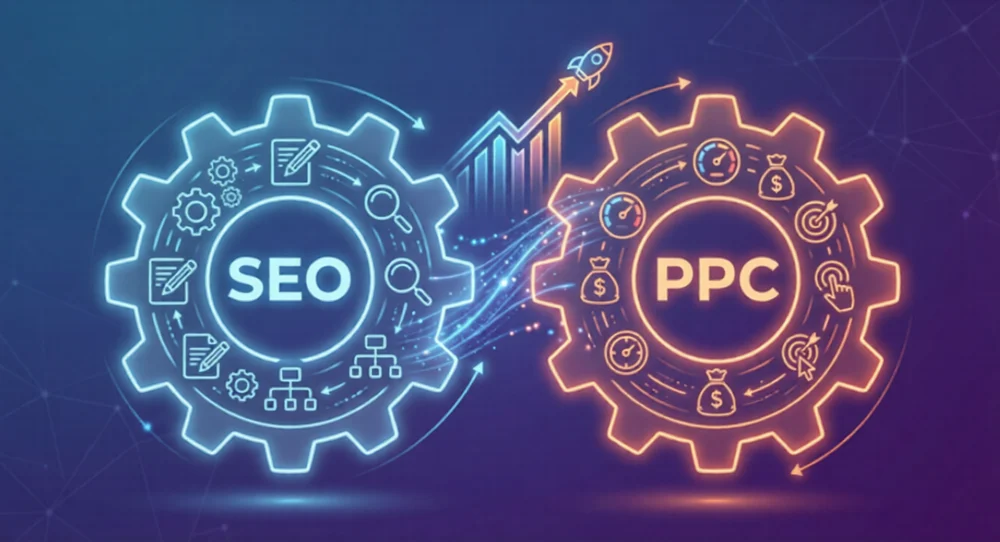
The biggest mistake a manager can make is forcing the SEO department and contextual advertising specialists to compete for budget, proving which is more important. In today's digital landscape, these channels shouldn't be at odds. They must work as a well-coordinated mechanism, with one tool covering the other's weaknesses.
This is how we at KelyanMedia build omnichannel strategies for our partners. Here are a few examples of how this works in practice.
1. Contextual advertising as reconnaissance in force for SEO
Organic promotion is expensive and time-consuming. Imagine you decide to create a new section on your website and write dozens of texts for it. You spend months working with SEOs, copywriters, and programmers to get the pages to the top, and then it turns out that people who search for these queries don't buy anything. They're just looking for information. Time and money are wasted, irretrievably.
How we do it: Before launching a large-scale SEO campaign for a new product group, we allocate a test budget and run a full-scale PPC campaign for two weeks. We receive real traffic and analyze the analytics. The Google Ads Search Terms report shows us not the fictitious fantasies of marketers, but the actual words used by people who made a purchase. It's these "golden," time-tested keywords that we pass on to our SEO specialists. We play it safe, protecting our clients from wasted money.
2. Capturing a monopoly on search results
Imagine a potential client entering the most compelling, highest-converting keyword in your niche. And they see the following:
- At the very top of the page is your eye-catching ad with extensions and additional links (PPC).
- Just below is a block of local maps, where your company is shown in first place with a 5-star rating (Local SEO).
- And under the maps is the first line of organic search results, where your article or category page is located (Classic SEO).
At this moment, a click occurs in the user's mind. They see you everywhere. You occupy the top spot on their smartphone or monitor. Competitors are pushed down. Trust in your brand skyrockets. The user subconsciously understands: if this company dominates the search results, it's the undisputed market leader. The likelihood of getting a click approaches 100%.
3. Intelligent position insurance
Google's algorithms are unstable. Even the most perfect website can temporarily lose rankings due to a Core Update. While the SEO team analyzes the drop, rewrites the text, and restores the page's authority (which can take several weeks), the business is left without sales.
How we solve this problem: We integrate SEO analytics and the advertising account. Specialized scripts continuously monitor the rankings of high-margin products. If the system detects that an important page has dropped out of the top three organic search results, the script automatically, without human intervention, triggers contextual ad impressions for these keywords. Clients continue to flow in. As soon as SEO specialists return the page to the top, the ads are disabled, saving budget. This is the perfect mechanism for uninterrupted sales.
Final Verdict: What to Choose in the End?
If you've read this far, you already understand that the question "Which is better: SEO or PPC?" doesn't have a straightforward answer. It's like asking, "What's more important for a car—a powerful engine or good aerodynamics?".
Contextual advertising is your gas and your engine. You fill up, press the gas pedal, and the car takes off instantly. This is critical for getting started, earning your first profits, and quickly maneuvering in the market.
Search engine optimization is the aerodynamics of your car body and the quality of your tires. At the start, you invest in development, wind tunnel testing (content creation, technical audits). You spend time. But when you reach cruising speed, the ideal shape of your car (website) allows you to speed ahead, outperforming your competitors, while using three times less fuel (advertising budget).

In 2026, in the era of neural networks, generative search, and total automation, attempts to survive on cheap direct marketing or poorly written SEO texts alone are doomed to failure. The winners will be those companies that think in terms of integrated marketing (SEM). Those who build a strong brand, share real-world expertise, and wisely balance investments between quick sales and long-term market growth.
Digital marketing today is a complex, multi-layered game of chess. If you feel you need a reliable grandmaster to help you navigate this game without wasting your pieces or budget, the team KelyanMedia I am ready to become your partner.
We don't sell abstract search rankings or empty clicks. We use cutting-edge web analytics tools, delve deeply into the specifics of your business, and build transparent, scalable customer acquisition systems. Systems that work not for agency reports, but for the stable growth of your net profit.
The future of online sales belongs to those who make data-driven decisions. Let's make them together.