


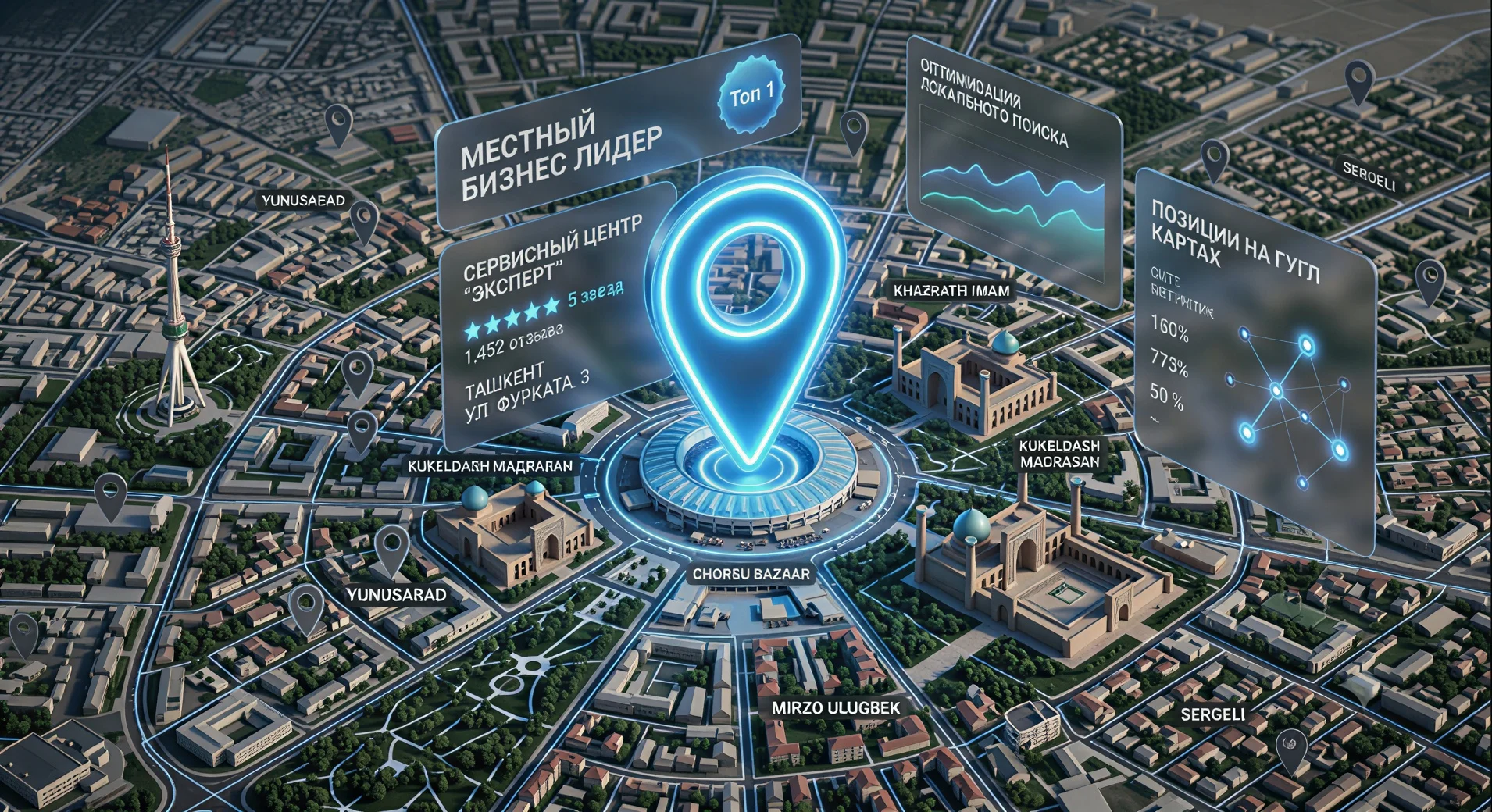
In 2026, local SEO in Uzbekistan is a fundamental performance marketing tool, generating up to 70% targeted leads for offline businesses. Successful map promotion in Tashkent relies on consistent NAP (Name, Address, Phone) data, mandatory bilingual optimization of maps (Uzbek and Russian), and ongoing reputation management (Review Management). Achieving top-3 rankings in Google Business Profile and Yandex.Business requires more than just a one-time setup, but systematic work with behavioral factors, geotags, and a local link profile (Citations).
Why is your business invisible to your hottest clients?
Over 15 years of working in search engine optimization, I've learned one ironclad rule: user behavior changes faster than businesses can adapt. Let's be honest: when was the last time you were stuck driving in traffic on Amir Temur Avenue, typed "where to get a haircut," and scrolled to the third page of Google search results? You didn't. And neither do your clients.
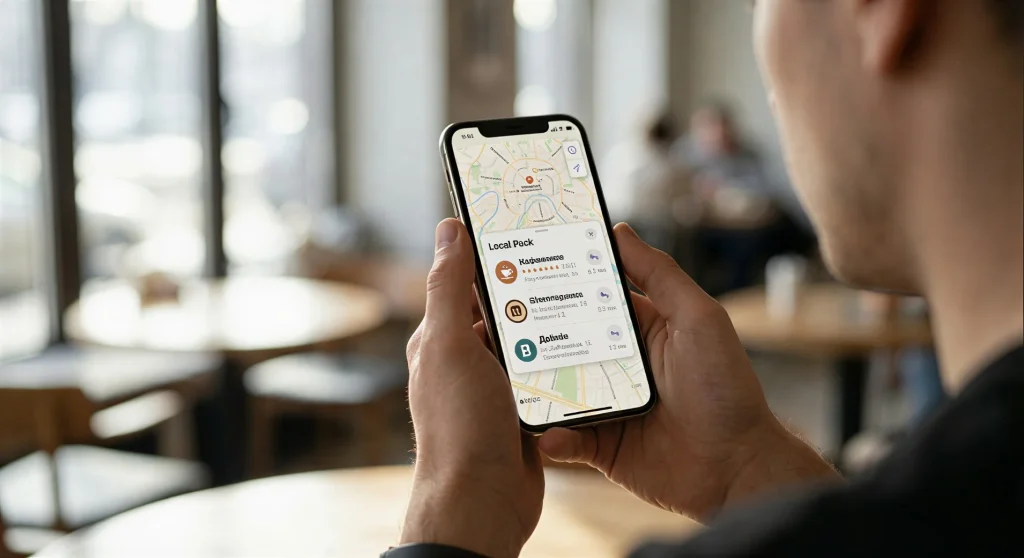
In the reality of 2026, Uzbekistan's digital market lives on smartphones. When people need a product or service "here and now," they look at maps. Search engines understand this perfectly. That's why they implemented Local Pack — that coveted block of three companies with a map, rating, and a "Call" button, which mercilessly pushes down even the most expensive and beautiful corporate websites.
Business owners often come to me and say, "We've invested thousands of dollars in a website redesign, but we're still getting no calls." I open my smartphone, enter their primary service, and together we see their competitors in the top three on the maps, whose websites look like they're from the 2000s, but whose geo-maps work like a Swiss watch.
Promoting Tashkent on maps isn't just a matter of "adding a point and forgetting." It's an aggressive, daily battle for the attention of users with the highest commercial intent. In this guide, I'll unveil the algorithms behind location services and explain step-by-step how to build a system that will force Google and Yandex to give you the best customers in your area.
Ranking Algorithms 2026: How Search Engines Choose Their Favorites«
There's a myth among entrepreneurs that getting into the top three is a matter of luck or the number of purchased reviews. Trust me, local search algorithms today are a paranoid system that doesn't take your word for it. They compare hundreds of signals before showing your business to users. In 2026, all this math rests on three pillars: distance, relevance, and prominence.
1. Distance: Geography as a Sentence and an Opportunity
The most obvious, yet most intractable, factor: Google will always prioritize those companies that are physically closest to the user at the time of search.
You can't move your office closer to your customers. But here's what you can and should do: optimize your content for micro-locations. If your auto repair shop is located in Yunusabad, simply specifying the street in the settings isn't enough. Your content, your responses to reviews, and your posts on your profile should literally scream out your location. Mention nearby metro stations, the names of famous shopping centers, and the historical names of neighborhoods. You should become more than just a "point" but an integral part of the area's digital map.
2. Relevance: Does Google understand what you sell?
The algorithm asks itself one question: «Does this company really solve the user’s problem?».
I often see a mistake when a multidisciplinary clinic selects a single, general category, "Medical Center," in the settings and expects a miracle. It won't happen. If someone searches for "pediatric ENT," the algorithm will show a highly specialized clinic that includes this service in its attributes and price lists. Relevance is increased by meticulously and meticulously filling out every field the geo-service provides: from the product list with prices to the questions and answers (Q&A).
3. Prominence: The Winner Factor
This is the exact metric professional SEOs work with. Let's say there are two coffee shops at the same intersection. The distance is the same, and their relevance (the "Coffee Shop" category) is identical. Which one will Google rank higher? The one with the higher Notability.
How does a search engine know you're cooler?
- He sees that your brand name is often searched directly.
- It analyzes external directories (Citations) and sees what other websites in Uzbekistan write about you.
- He's tracking Review Velocity — the speed at which fresh reviews appear. If you have 100 reviews, but the last one was written a year ago, and a competitor has 20 reviews, but they were written this week, the algorithm will favor the competitor. For Google, fresh data is a sign that a business is active.
Google Business Profile (GBP): The Anatomy of a Perfect Setup
If you want to monopolize search results, your Google Business Profile in Uzbekistan must be configured with surgical precision. One wrong move and your account will be suspended, which in our region can involve a lengthy legal battle with tech support.
NAP's Iron Rule: A Mistake That Costs Millions
NAP (Name, Address, Phone). Remember this acronym. It's your digital DNA. Search engines are foolish in their straightforwardness. If your website says "Oasis LLC," Google says "Oasis Restaurant Tashkent," and the sign says "Oazis," the algorithm begins to doubt whether it's the same company. And where search engines doubt you, you won't rank highly.
I make my clients perform a NAP audit on all sites. Phone numbers must match, down to the dash. The address must be written in a consistent format. If you have a "B" building, it must be "B" everywhere, not "B" or "building 2." Any inconsistency will shatter your credibility.
Dangerous trend: Many owners try to incorporate keywords into their listing titles. For example, "Dentistry Implants Cheap." In 2026, Google will severely penalize this. The name in your listing title must match your actual brand on your sign and in your documentation.
Products, Services, and Attributes: Showcase within Search
Why force users to go to your website when you can sell them a service right in the search results?
- Categories: Choose one primary and up to nine secondary. Don't mix and match.
- Products: Don't be lazy in uploading high-quality product photos, and at least include a price range (if you're a B2B business). Add buttons with UTM tags. When the algorithm sees that people are clicking on your products within Google Maps, it boosts your ranking.
- Attributes: In Tashkent, "air conditioning" is crucial in the summer. For many, it's the availability of a payment terminal (Uzcard/Humo) or a convenient wheelchair ramp. Check everything. This narrows the search funnel but maximizes traffic conversion.
Bilingual Optimization (UZ/RU): The Key to the Local Market
This is where 80% companies in Uzbekistan stumble. You can't ignore the country's linguistic specifics. Your target audience is looking for services in both Russian and Uzbek (and in both Latin and Cyrillic).
If you write posts, describe your services, and respond to reviews only in Russian, you're voluntarily ceding a huge market share to competitors. Google is incredibly good at analyzing semantics. High-quality, manual (not machine!) translation of your company description into Uzbek is critical for local SEO. Create content that's understandable and relatable to both language groups.
The Yandex.Business and 2GIS Ecosystem: Why You Shouldn't Put All Your Eggs in One Basket
My experience shows that a "Google-only" strategy in Tashkent is flawed. The audience is segmented. If you're targeting pedestrians, tourists, and young people, Google Maps is the way to go. But if your business caters to drivers (service stations, car washes, drive-thru cafes), Yandex.Maps is your best partner.
Specifics of Yandex.Business
Yandex operates differently. It's more commercialized and heavily relies on behavioral metrics.
- Price lists: Yandex loves structured data. If you haven't uploaded your menu or price list in YML/XLS format, your card will never reach the coveted 100% completion rate.
- Feedback Strength: Yandex's algorithm is incredibly wary of inflated ratings. A review from a user who creates routes in the navigator every day and has a level 10 "City Expert" rating will outweigh twenty reviews from empty accounts.
- Synergy with advertising: Paid geo-location in Yandex (green label) provides a powerful boost to organic traffic. But buying ads on an empty, unoptimized page is a waste of money. SEO first, advertising second.
Specifics of 2GIS
2GIS is the microsurgery of local search. Users value this service for its accuracy. For 2GIS, it's crucial to indicate the entrances. If you're located in a huge business center on Mustakillik Avenue, your client shouldn't have to run around the building. Indicate the entrance, floor, office number, and attach a photo of the door. The more accurate the data, the higher the user's loyalty and the higher the rating for your card.
Review Management: Reviews as a Business's Main Weapon
Reviews are a new form of word of mouth, but with a reach of thousands. Search engines read reviews, analyze sentiment, and look for keywords.
How to legally build a review flow
Buying reviews on freelance platforms in 2026 is like shooting yourself in the foot. Yandex and Google's neural networks analyze IP addresses, device geo-history (was this person actually in your area?), and connection graphs. Fakes are removed en masse, and the profile is deprecated.
You only need to work with a real database:
- CRM integration: This is the gold standard. The customer purchases the product, and the deal status in AmoCRM changes to "Successfully Completed." Two hours later, the customer automatically receives a personalized message on Telegram: «"Name, thank you for your purchase! Help us improve by rating our work using the link…"».
- QR table tents: If you have an offline location (restaurant, clinic), QR codes should be located everywhere where the customer spends their time waiting.
- Personal request: There's nothing more effective than a manager's sincere request. Train your staff with a script: "If you're happy with everything, we'd appreciate a few words on the cards.".
Dealing with Negativity: The Art of Turning Enemies into Brand Advocates
I always tell my clients: a card with a rating of 5.0 is suspicious. A rating of 4.7-4.8 with high-quality negative feedback converts better.
Speed of response is crucial. Negative feedback must be responded to with lightning speed, while the client's emotions are still high.
What you shouldn't do: Make excuses, be rude, use formulaic replies in the style of «your opinion is very important to us.».
How to do it right: Apologize for the client's emotions (you don't necessarily have to admit guilt if there is none, but acknowledge their right to be upset), steer the dialogue in a constructive direction, and take the conversation offline.
«"Hello! My name is [Name], I'm the manager. I'm truly sorry that your visit left such an impression. We strictly adhere to standards, and the situation you described is an emergency for our team. Please send us your phone number on Telegram @username so I can personally look into the situation and find a solution for you. I look forward to hearing from you.".
Local Link Building (Citations): Building Online Authority
Many people think links are only needed for classic SEO. This is a mistake. For the Prominence factor, Google's algorithm requires proof that you actually exist and are actively involved.
Citations are mentions of your business (your NAP) on third-party resources. Your goal is to systematically register your company in all reputable directories in Uzbekistan.
Where you must be:
- Golden Pages (Uzbekistan Directory)
- Yellow Pages Uzbekistan
- Norma.uz
- Industry portals (new building aggregators, medical directories, restaurant guides).
Each such mention, even if the link is not clickable, but contains the exact name, address, and phone number from your Google card, adds weight to you in the eyes of the search engine.
Understanding the mechanics with practical examples: How we grow our business
Words remain just words until they're backed by real-world cases. I want to show you how systematic point management works in practice, using two completely different local business models with which KelyanMedia has extensive experience.
Model 1: The Beauty Industry (using the example of Barbermatch barbershops)
A barbershop is a classic local business, where decisions are made impulsively, based on visuals and proximity to home.

Our strategy for working in the highly competitive environment of Tashkent:
- Visual warm-up and EXIF optimization: We don't just upload photos of interiors or haircuts. We take raw photos and embed metadata (EXIF) into them before publishing. The file properties record the geocoordinates (latitude and longitude) of the barbershop itself and tags, such as "fade Tashkent." When Googlebot scans the photo, it receives a powerful geo-signal.
- Systematicity: The algorithm loves life. We're implementing a policy of publishing new content (photos of work, short posts about new artists) at least twice a week.
- Seamless recording: Users shouldn't have to search for how to book an appointment. We integrate direct links into Google Maps buttons to online booking widgets with pre-defined UTM tags. This allows us to open analytics at the end of the month and show the business owner: "Look, maps brought you 45 new bookings worth X amount of soums.".
Model 2: Highly specialized auto services (using Glasscar auto glass as an example)
This is a niche with completely different user behavior. No one is looking for windshield repair "just to look at it." It's an urgent need. Trust and information accuracy are key here.
Our expert positioning strategy:
- Maximum specificity of categories: Unlike barbershops, it's detrimental to be "all things to all people" here. We narrow our categories to the limit, eliminating generic terms like "Car Service," and focus on precise intent: "Crack Repair," "Auto Glass Installation.".
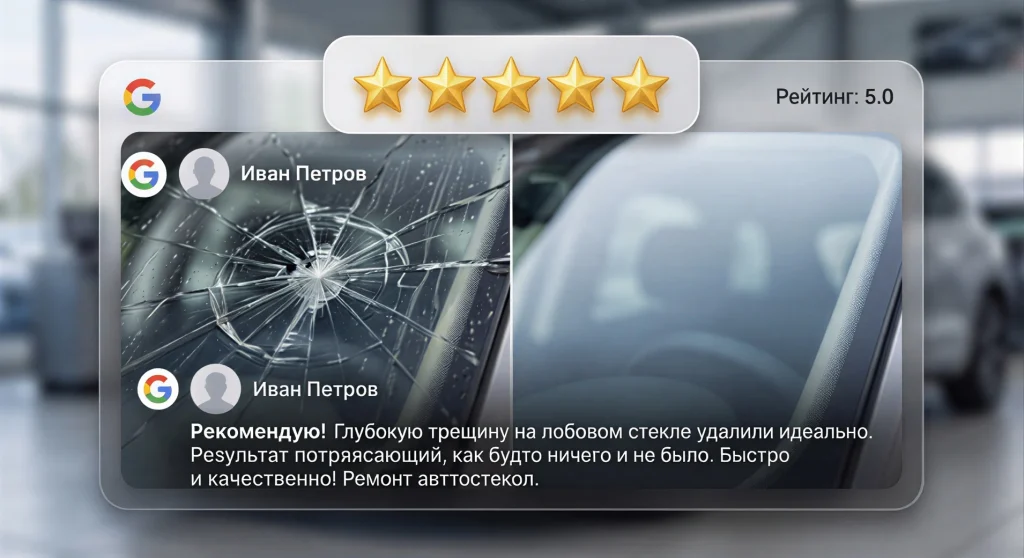
- Before/After Content: A client who has a cracked windshield on the highway needs proof of your expertise. Continuously publishing windshield rescue cases with before-and-after macro photos is the best trust booster, built into Google Maps.
- Bilingual technical content: As we've implemented in long-term projects, translating complex technical descriptions of services, warranties, and technologies into competent Uzbek allowed us to capture a huge volume of local traffic within a 10-15 km radius of the service. Competitors who were too lazy to translate the content were left far behind.
KelyanMedia Expertise: Transition from Chaos to System
Optimizing one location yourself and asking friends to leave a few reviews is possible. But when your business starts to grow, branches open, and competitors begin to aggressively compete, an amateurish approach will lead to a loss of market share.
What we do at KelyanMedia when we take on a business for local search support:
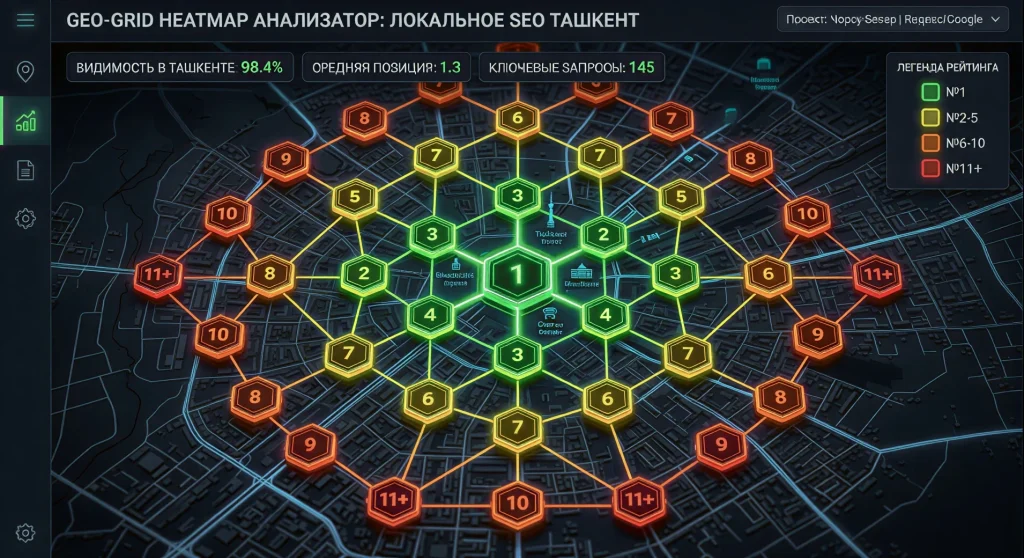
- Deep GEO Audit: We don't look at rankings "from the center of Tashkent." We use Geogrid tools to create a grid around your location. We show you a heat map: how users see you at 500 meters, 1 kilometer, and 5 kilometers. This reveals all your weak points.
- Cleaning and Gluing Duplicates: One of the main pain points for established businesses in Uzbekistan is the presence of dozens of "dead" cards with invalid addresses created by former employees or clients. This digital garbage ruins your rating. We conduct a full legal and technical cleanup, contacting support services to remove duplicates.
- ORM and Automation: We don't write fakes. We help you build internal business processes so that collecting genuine reviews from real customers is automated, and responses to negative feedback are quick and professional.
Local SEO in 2026 isn't a one-time magic pill. It's an engineering and analytical process. And if you entrust this process to professionals, maps will become the most cost-effective lead source in your marketing arsenal.
