


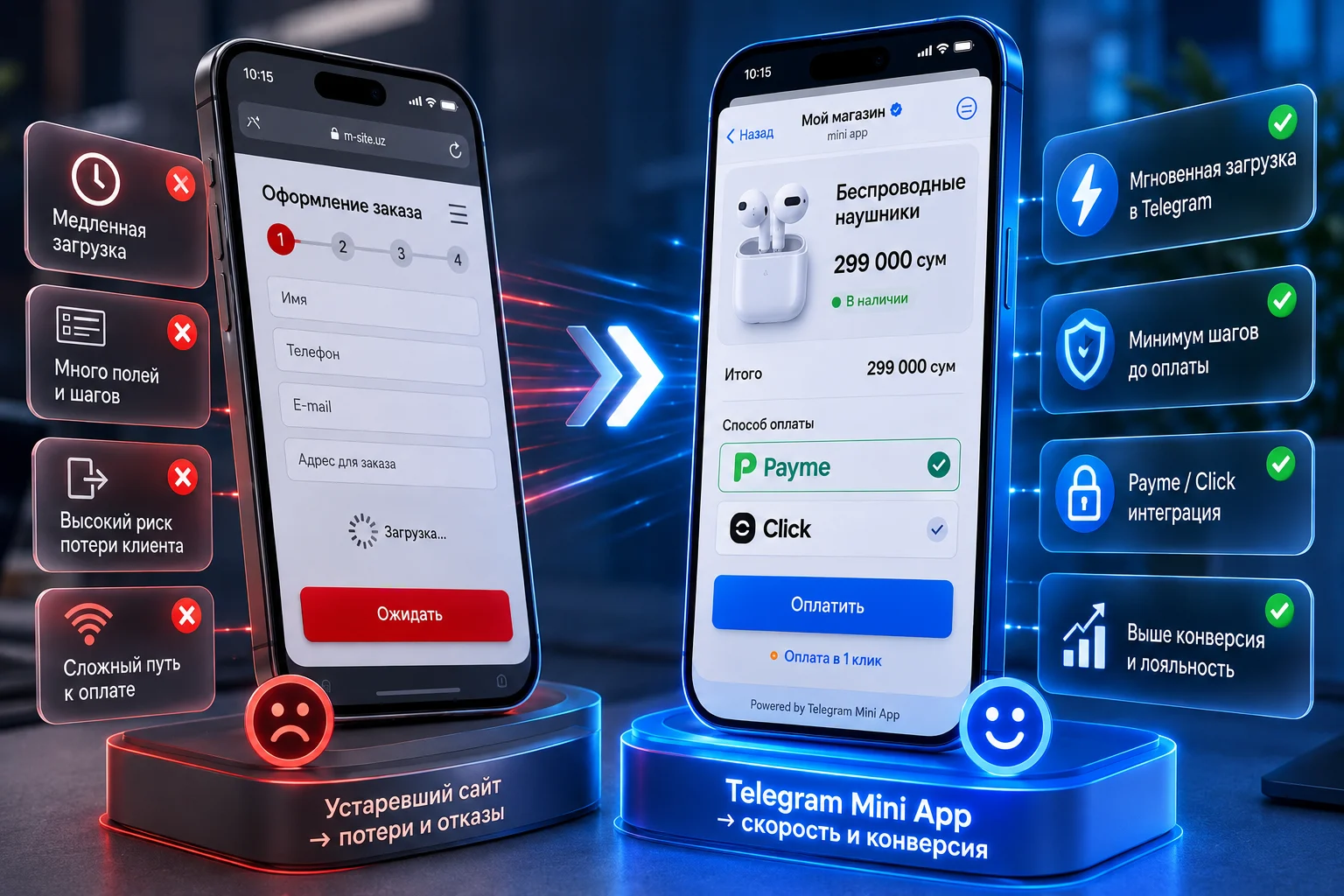
Choosing between Telegram Mini Apps (TMA) and a traditional website in Uzbekistan in 2026 isn't a matter of "fashion," but rather a matter of conversion physics. For mobile traffic, TMA wins due to the elimination of SMS authorizations and native integration with Payme/Click, reducing the cost per lead (CPL) by 2.5-3 times. However, websites remain indispensable for SEO and long-term B2B transactions. The study breaks down the details of CJM, the technical stack, and platform selection criteria.
1. What really happened to mobile traffic in Uzbekistan
Let's look at how the average person in Tashkent, Samarkand, or Fergana uses a smartphone. They don't spend time in a mobile browser the way we do at our desktops. The browser on a phone has become an alien environment, one people stumble into by accident and try to leave quickly.
Today, Telegram is practically the "main operating system" for smartphones in Uzbekistan. It handles absolutely everything: from family chats and reading the news to ordering food, making appointments, and paying utility bills.
When marketers launch ads and try to "pull" users from Telegram to an external website, an invisible disaster occurs. The user clicks the link, the messenger closes, and an external browser like Safari or Chrome starts loading... And with every millimeter of this journey, the business loses money.
What is the main problem with external websites on smartphones?
The mobile web is overloaded with micro-stresses. If a page takes longer than two seconds to load, people simply return to chats. But even if the site loads quickly, the main conversion nightmare begins: authorization.
To place an order or submit a request on a regular website, the user is offered:
- Enter name.
- Enter your phone number.
- Wait for an SMS with an OTP code (which is periodically delayed due to operator gateways).
- Switch to the Messages app and copy the code.
- Return to the browser, which during this time could have successfully reloaded the page and reset the entered data.
Each of these actions is a huge gap in the sales funnel. In Telegram Mini Apps, this problem doesn't exist at all.
2. The Anatomy of Telegram Mini Apps: Why They Work So Smoothly
Telegram Mini App (TMA) isn't just another chatbot that sends buttons in response to commands. It's a fully-fledged, perfectly coded web app (powered by React, Vue, or Svelte) that runs right inside the messenger, on top of your chat.
For the user, it's seamless: they click a button in a Telegram Ad, and a beautiful, smooth app instantly appears—without reloading or switching to other apps.
TMA's key engineering strengths:
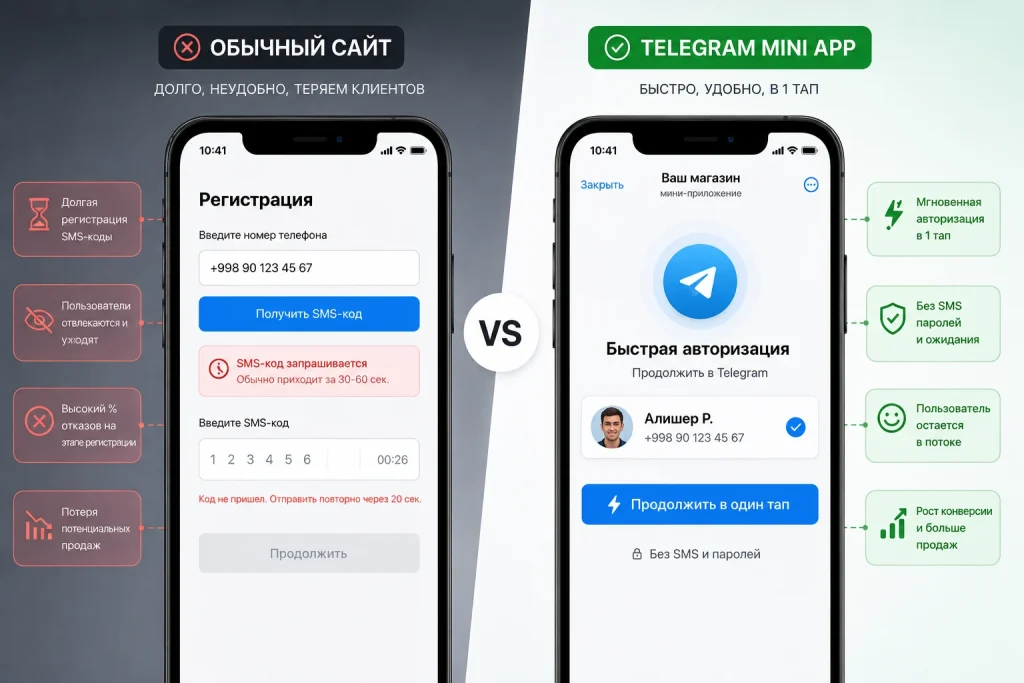
- Authorization without SMS and passwords: As soon as Mini App opens, the Telegram client sends an encrypted initData string to the server. The app already knows who's in front of it: their name, username, language settings, and verified ID. There are no registration forms. The user is immediately taken to the directory or service.
- Payment in two taps (Payme, Click, Uzum): The user clicks "Pay," the system immediately calls the native Deep-Link link, pulls up the banking app, the person confirms the debit using biometrics (Face ID/fingerprint), and immediately returns back to the Mini App with a receipt.
- Push notifications instead of expensive SMS: After the first login, the user remains connected to your bot. Now you can send them service messages, order statuses, and personalized discounts absolutely free, without paying aggregators for each SMS.
3. Analysis of the Niche Triad: Differences in Conversion and Numbers
To avoid abstractions, let's analyze how users (CJMs) behave in three completely different business sectors when clicking on ads on a classic website and in a Mini App.
Niche 1: Fintech and Microcredit (Loan Application)
In the microfinance sector, seconds matter. People want to get a quick quote or submit an application right away.
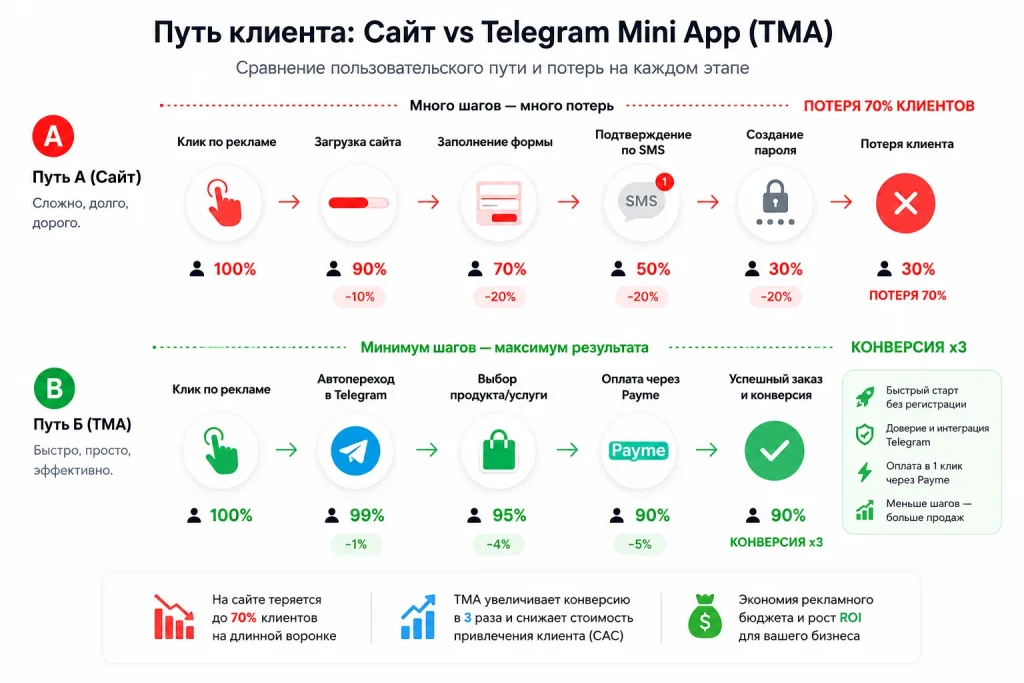
- On a regular mobile site: The client logs in, sees a long form, begins entering data, and waits for SMS confirmation. While entering their passport and phone number, up to 60% of traffic is lost due to the reluctance to fill out small fields on a smartphone screen. Total conversion to application: ~3.8%.
- In Telegram Mini App: The client opens TMA, and their profile is already recognized. The app offers a short, interactive, three-step questionnaire with large buttons. The phone number is confirmed by pressing a single, native Telegram button. Total conversion to application: ~11.4%. Cost per application (CPA) drops by 3 times.
| Funnel stage (CJM) | Classic mobile site | Telegram Mini App (TMA) |
| 1. Click on an ad | Switching to an external browser, delay 3-4 seconds. | Instant opening over chat (< 0.5 sec). |
| 2. Login and registration | Enter phone number, wait for SMS, enter OTP code. | Automatic authorization by Telegram ID. |
| 3. Filling out the questionnaire | 8-10 small fields manually on the screen. | Step-by-step questionnaire with auto-completion. |
| 4. Result (CR) | 3.8% from clicks | 11.4% from clicks |
Niche 2: EdTech (Online Education and Courses)
The main goal here is to let people immediately try the product (watch an introductory lesson, take a test) while they still have the impulse.
- On a regular mobile site: Clients are asked to register via email, confirm their email address, and create a password. 80% people put this off until later and close the tab. Student Acquisition Cost (CAC): $15–$22.
- In Telegram Mini App: Click the button and watch the first lesson right in the messenger. The system automatically records your progress. In the evening, the bot will send a gentle reminder: "You've watched lesson 50%. Continue?". Student Acquisition Cost (CAC): $6–$9.
Niche 3: E-commerce (Clothing Brand with Delivery)
In retail, clothes are bought with the eyes and emotions. It's important to offer a user-friendly catalog and fast delivery.
- On a regular mobile site: The size selection is small; in the shopping cart you need to manually enter the Tashkent address, select the district, and enter the map.
- In Telegram Mini App: The catalog flies at the speed of a native app, geolocation for delivery is retrieved in one click via built-in Telegram maps, and payment is processed through Payme in 3 seconds. Conversion increases from 1.5% to 4.5%.
4. Honest Talk: Who STILL Needs a Traditional Website in 2026?
It would be a professional mistake to claim that Telegram Mini Apps are a panacea and that traditional websites should be thrown out. This is not true. There are vast swathes of business where a website has been and remains the foundation.
When a website is absolutely irreplaceable:
- Industrial B2B and wholesale sales: If you sell rebar, facade panels, or factory equipment, your customers are procurement departments and engineers. They sit at large desktop monitors, search for suppliers through Google or Yandex, download cumbersome PDF estimates and DWG drawings, and compare GOST standards. They need a full-fledged, robust corporate portal.
- Businesses that live off SEO traffic: Content inside Telegram Mini Apps is closed to the outside internet. Googlebot or Yandex search robots cannot access your Mini App and index its pages. If your business model relies on free organic search traffic (e.g., legal services, clinics, medical references), a traditional website with comprehensive SEO optimization is essential.
- Giant marketplaces: When you have a catalog of 200,000 products with thousands of filters and attributes, accommodating all of this within a mobile messenger window becomes architecturally challenging. In such cases, marketplaces build a desktop website for in-depth search and TMA as a tool for rapid repeat sales.
Comparative criteria for choosing a platform
| Evaluation criteria | Classic corporate website | Telegram Mini App (TMA) |
| Main source of traffic | SEO (Google/Yandex), Contextual advertising, Direct transitions. | Telegram Ads, Channel Seeding, Internal Sharing. |
| Device type | Desktop (30–50%) + Mobile Web (50–70%). | Mobile (99%). |
| Search engine indexing (SEO) | Full indexing of all pages. | No indexing (Closed loop). |
| Launch speed | 2–5 months. | 3–6 weeks. |
| User return | Low (Retargeting and SMS mailings are required). | High (Free Push Notifications via Bot). |
5. How KelyanMedia designs and assembles TMA ecosystems
At KelyanMedia, we approach Telegram Mini App development not as "writing code," but as building the engineering component of your sales system. The app shouldn't be a standalone application—it should be seamlessly integrated with your internal infrastructure.
Our approach to development:
- One-handed UX: We design Atomic Design interfaces so that users can comfortably press key buttons with their thumbs on the go, regardless of the screen size.
- Fault-tolerant Backend: The app is built using the React/TypeScript + Fastify/Go stack and packaged in Docker containers. This ensures that if you launch a large-scale advertising campaign on Telegram Ads and tens of thousands of people visit the app simultaneously, the server won't crash.
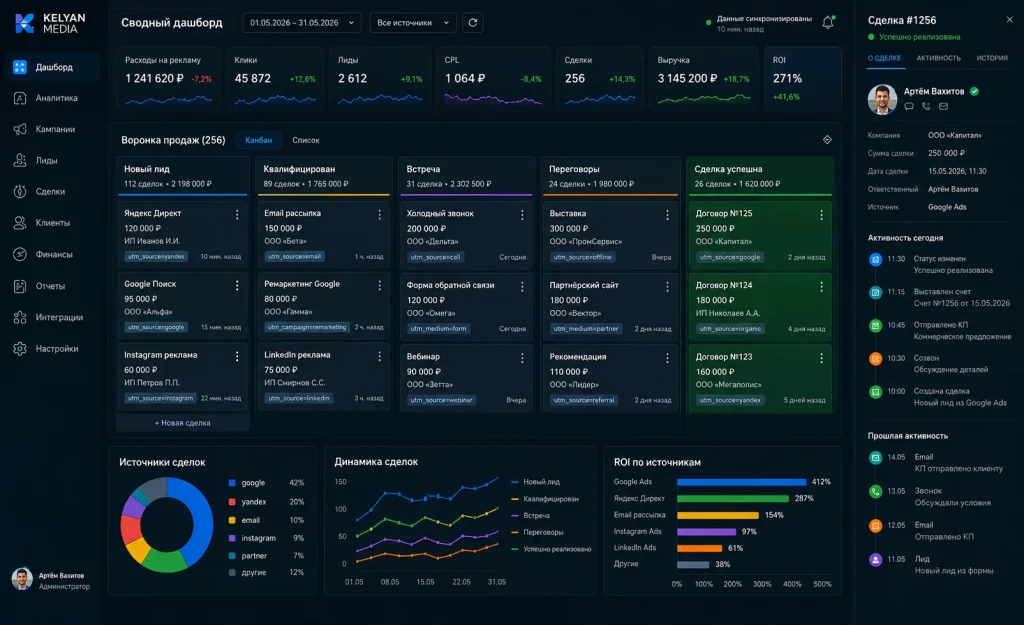
- Two-way integration with your CRM: Mini App doesn't just collect requests. It automatically transfers them to your AmoCRM or Bitrix24 A full client profile, all UTM tags, ad parameters from Telegram Ads, and an immediate manager assignment.
- Synchronization with the warehouse (1C / MoySklad): Prices, balances, and product listings in the Mini App are updated in real time.