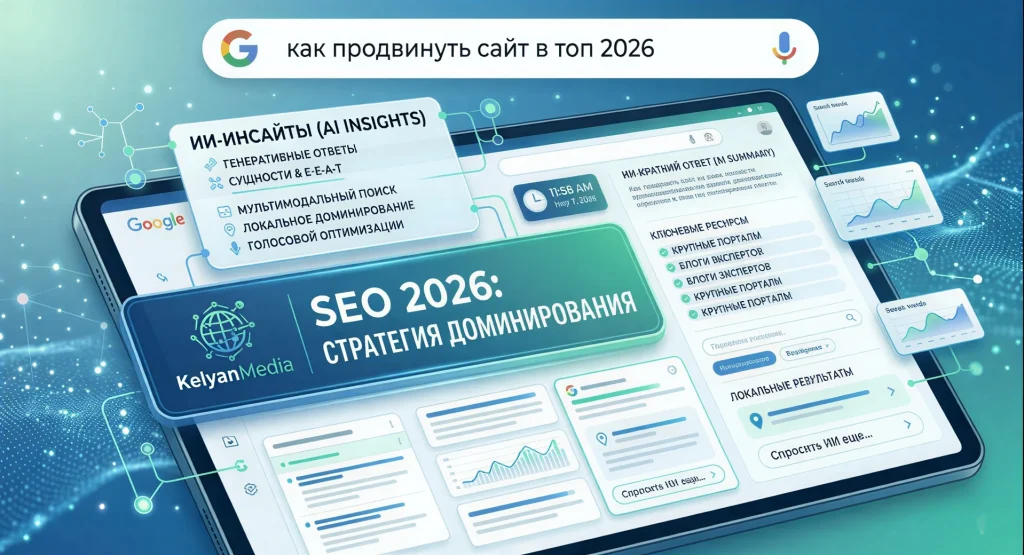


From the editors of KelyanMedia: We didn't write this article to scare you with another "apocalypse." We wrote it to give you a roadmap. The search landscape has changed more in the last two years than in the previous twenty. If you continue to invest only in "links and keyword-rich text," you're investing in the past. The time for GEO has arrived.
Introduction: Why Old School Marketing Isn't Paying the Bills Anymore
Imagine you're the owner of a large furniture manufacturer in Tashkent. In 2018, your customer journey was linear: someone searched for "buy a sofa," saw your ad or website in the top three results, clicked through, and made a purchase.
In 2026, this path looks like a complex neural labyrinth. The user asks their smart glasses or the AI assistant on their smartphone:
«"Listen, I need a Japandi sofa that can withstand Maine Coon claws, and I need delivery to Samarkand by Saturday. Show me the best options based on reviews and check if they're in stock."».
AI doesn't just produce a list of websites. It analyzes thousands of parameters: real-time product availability, the sentiment of reviews on independent sites, expert reviews from designers, and your logistics network. It produces one or three specific options.
If your company isn't in this short answer, you're not in the market. Welcome to the era GEO (Generative Engine Optimization). In this article, we'll explore how to transform your business into the very entity that AI will recommend first.
Part 1. Anatomy of a Disaster: How Google and Yandex Killed Classic SEO
To move forward, we need to understand what exactly is broken. In 2026, we expect three critical changes in search engine behavior.
1.1. Dominance of SGE (Search Generative Experience)
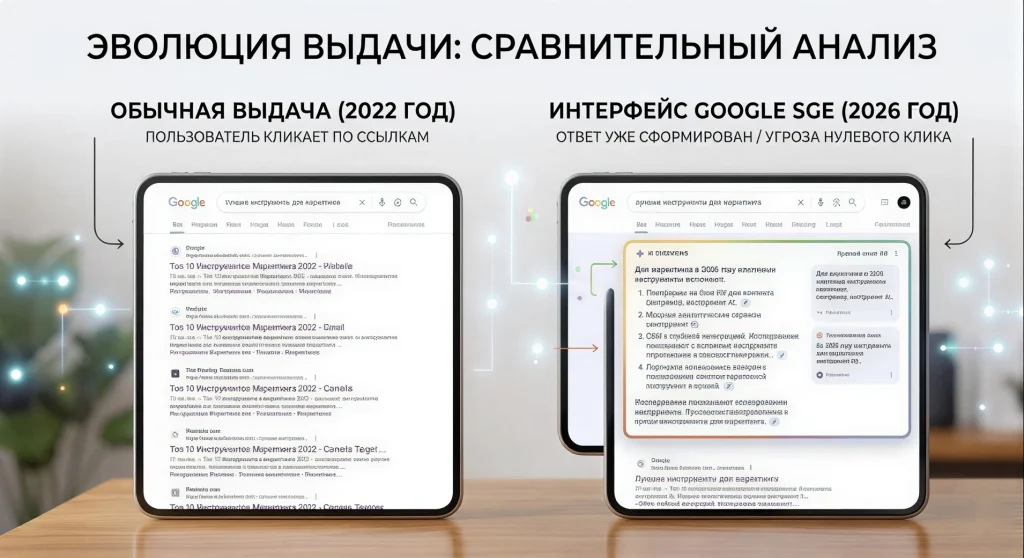
Google has finally switched to an interface where the neural network's response takes up the first screen of search results. This has led to the phenomenon Zero-Click Search. Why would a user visit your website if AI has already written a prescription, compared prices, or created a workout plan right in the search bar? For information resources, traffic fell by 70–80%, while for commercial sites, only those included in the "citations" within the AI response survived.
1.2. Transition from page indexing to meaning indexing
Previously, a search engine robot was a "reader." It scanned text for words. Now the robot is an "analyst." It uses technology RAG (Retrieval-Augmented Generation). It doesn't just look for words, it looks for facts. If your text contains general phrases like "we're a team of professionals," the AI will mark it as "zero-value content" and discard it from the search results.
1.3. Death of behavioral factors in their old form
Previously, it was possible to "inflate" website visits. In 2026, AI analyzes User Satisfaction Beyond your website. It sees how often people ask about you on social media, whether your brand is mentioned in the context of solving problems, and what your reputation is on messaging apps. Search has become social and decentralized.
Part 2. GEO Foundations: What is Generative Optimization, Really?
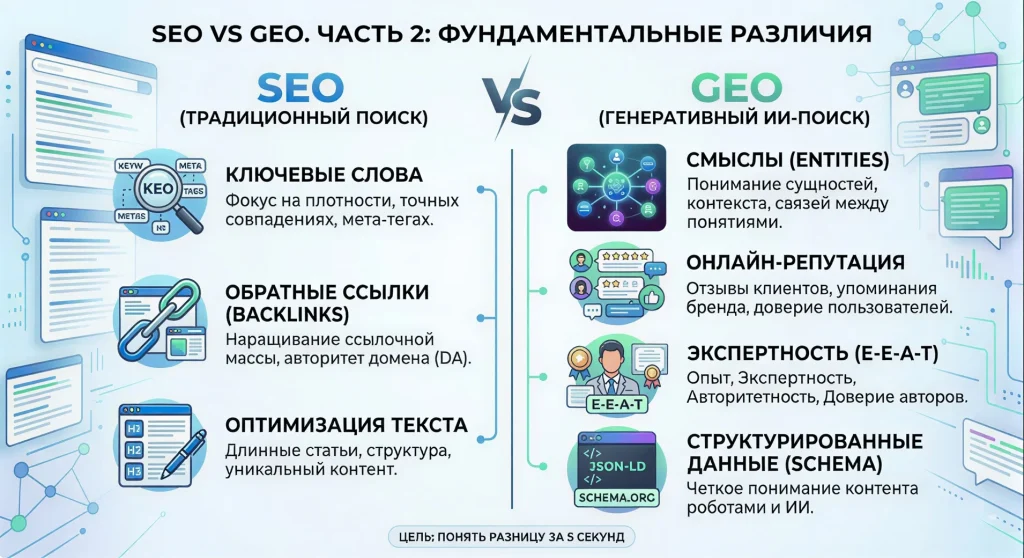
GEO is not a replacement for SEO, it is its highest form of evolution. If SEO is about optimization pages under algorithms, then GEO is engaged in optimization brand under large language models (LLM).
2.1. The Brand Entity Concept
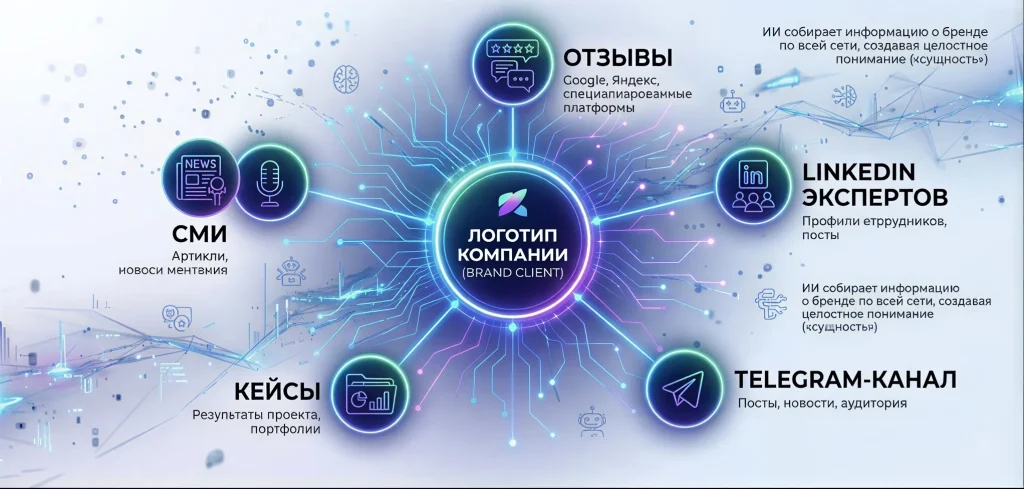
In an AI database, your business isn't a domain name. It's an "entity" with a set of attributes.
- Example: KelyanMedia is not kelyanmedia.uz. It is an object associated with the attributes: [Marketing in Uzbekistan], [GEO Expert], [Retail Cases], [High Trust].
- GEO Task: Weave these connections into the AI vector as tightly as possible. So that whenever a search query about marketing in a region is made, the neural network instantly pulls up your brand.
2.2. Information Gain as the Main Metric
This is a term every business owner should know in 2026. If you publish an article that is 100% identical to Wikipedia or your competitors' articles, your Information Gain is zero. Google has introduced filters that only allow content that adds information to the index. new knowledge:
- Unique photographs of the production process.
- Real numbers and statistics about your company.
- Personal opinions of experts that contradict the "generally accepted" ones.
- Video evidence of completed work.
Part 3. EEAT 3.0: Why the "Face" is more important than the "Code" in 2026«
At KelyanMedia, we've always maintained that people buy from people. In 2026, Google made this an official requirement. The EEAT (Experience, Expertise, Authority, Trustworthiness) system became the basis for ranking.
3.1. Experience is the king of content
AI has learned to perfectly imitate theory. But it can't imitate experience. Articles written under the name "Company" are no longer valid. Every piece of content must have an author.
- Case: If you sell building materials, an article about choosing bricks should be co-authored by your chief technologist, complete with a LinkedIn profile and links to their presentations. AI verifies this person's credibility. No expert, no trust, no ranking.
3.2. Off-site Authority
Your authority in 2026 is not measured by backlinks, but mentions without links (linkless citations). If major media outlets, bloggers, and experts in your niche mention your company's name, AI considers this a signal of authority. This is a new form of link building—now called Digital PR.
3.3. Trustworthiness and Transparency
Google analyzes your legal information, reviews on Maps, the transparency of your return policies, and even the presence of a physical office. In the era of deepfakes and AI fakes, a business's physical presence has become a premium ranking factor.
Chapter 4. GEO Technology Stack: A Guide for the Technical Department
Let's get down to specifics. What should your programmer do right now?
4.1. Implementation of Semantic Schema.org
Regular microdata is no longer enough. In 2026, we will use knowledge graph. You should mark not only the "price", but also the connections:
- KnowsAbout — what your company knows.
- MemberOf — what associations are you a member of?.
- HasCredential — which certificates your employees have. This allows AI bots to instantly add your company to the appropriate memory slots.
4.2. Optimization for «Voice & Conversational Search»
People have stopped writing in chopped-up phrases. In 2026, search is a dialogue.
- Long-tail keywords: Your keywords now look like 10-12 word sentences.
- Change of structure: Articles should be structured according to the principle "Question - Direct, concise answer - In-depth explanation." The AI will capture the direct answer in the SGE block, and for the explanation, the user will be redirected to the website.
4.3. LLM-Readability (Readability for Models)
The website should be easy to parse with neural networks. It should have clean code, no heavy rendering-blocking JavaScript, and .json or API entrypoints so AI agents can quickly retrieve your inventory and pricing data.
Part 5. GEO in Uzbekistan: Local Features
The Uzbek market in 2026 is a unique mix. On the one hand, there's the rapid penetration of AI, and on the other, there are unique consumer habits.
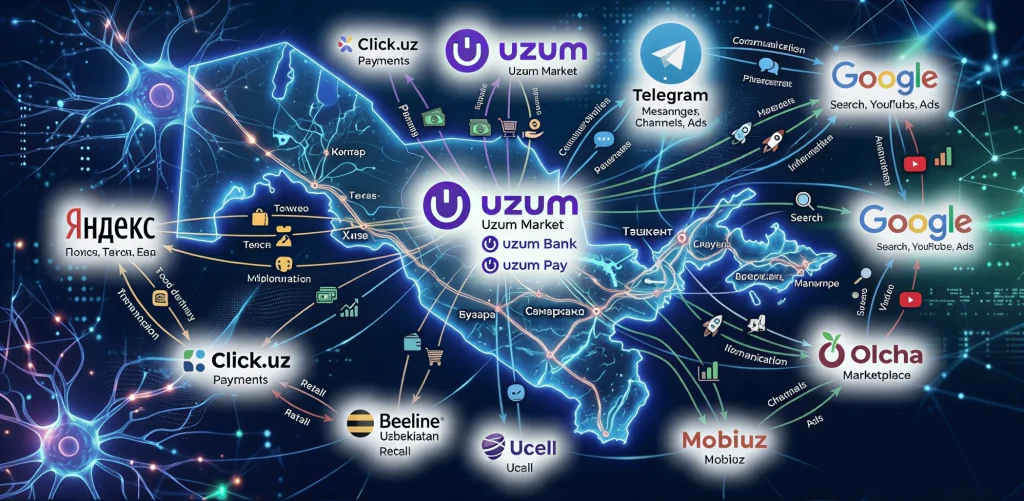
- Localization at the level of meanings. Translating content into Uzbek using AI is a dead end. AI search engines see the machine-like nature of translation and downgrade it. Deep localization is needed, taking into account cultural codes (mentality, local holidays, business traditions).
- Ecosystemicity. In Uzbekistan, searches often begin within Uzum, Telegram, or Yandex. GEO in our region means presence in all of these places. If your product is listed on Uzum and reviewed on a popular Telegram channel, Google will connect these dots and boost your site.
- Trust via Telegram. For Uzbek businesses, the Telegram channel has become a "second website." At KelyanMedia, we integrate Telegram content into the website structure, providing a powerful AI signal about the brand's live activity.
Part 6. Deep Dive Content Strategy: How to Write to Be Loved by People and Robots
In 2026, content is not text. It's value. We offer a four-step methodology.
Step 1: Research insights, not frequencies
Forget Wordstat or Keyword Planner as your only source. Go to comments, support chats, Reddit discussions, or local forums. Find questions that AI gives poor, boring answers to. These are your growth areas.
Stage 2. Multimodality
The 2026 blog post is:
- Text (for LLM).
- Short video summary (for Google Video and YouTube).
- Data infographics (for Google Lens visual search).
- Audio version (for podcast aggregators). AI engines value a variety of formats, as this allows them to respond to the user in any situation (while driving, on the run, in the office).
Stage 3. Expert verification
Every piece of content at KelyanMedia goes through a "reality filter." We interview a real specialist at the client company. These quotes, formatted as reviews or comments, provide the information gain Google is looking for.
Stage 4. Regular updating (Freshness Factor)
In the world of GEO, information becomes outdated within weeks. AI won't recommend an article about 2024 taxes in 2026. Your blog should be a "living organism." Updating old articles is more important today than writing new ones.
Part 7. GEO Economics: ROI, Conversion, and Why It's Cheaper Than Advertising
Businessmen often ask, "How much does this cost and when will it be returned?" Let's compare.
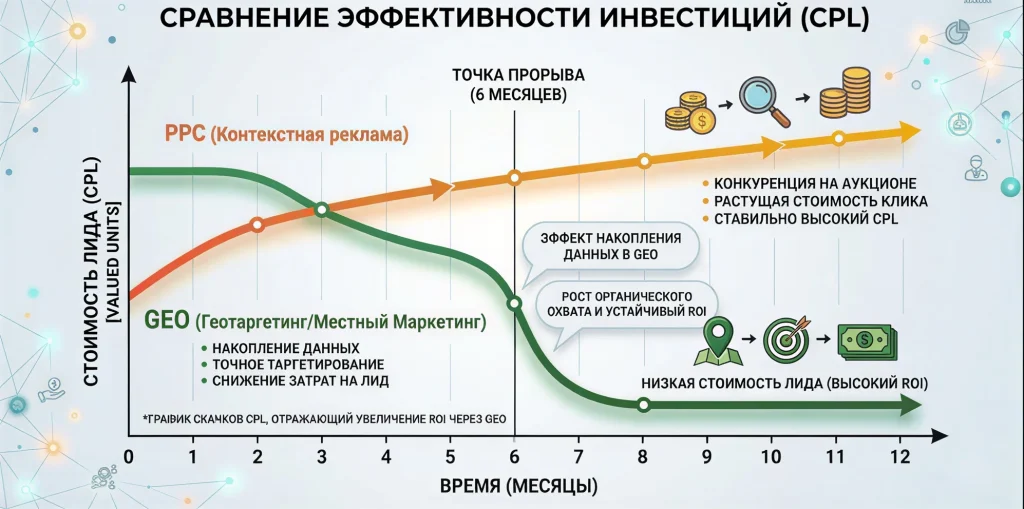
- PPC (Contextual Advertising): In 2026, auctions are overheated. AI assistants often block or hide ads. You pay for every click, which may not result in a sale. Once the budget is exhausted, the flow of customers dries up.
- GEO: This is your brand's capitalization. By investing in expertise and a digital footprint, you create an asset. When AI recommends you for free in a response, customer trust is 5-7 times higher than with a banner ad.
The math is simple: The cost of customer acquisition (CAC) through GEO may be higher at the start (due to the costs of high-quality content and PR), but after 6–12 months it falls by 40–60% compared to paid channels.
Part 8. Killer Mistakes: How to Avoid the Filters of the Future
- AI spamming. Using ChatGPT to generate 100 articles per day. Google learned to recognize AI-generated text patterns. The result is complete domain deindexing.
- Ignoring negativity. In 2026, "bad reviews" are poison for GEO. If AI sees unresolved complaints on third-party sites, it will remove you from recommendations.
- Technical debt. Slow websites on old engines. If an AI bot takes more than 2 seconds to render a page, it quits. Your information remains "unreadable" for the collective intelligence of neural networks.
Chapter 9. Business Owner's Action Plan (Checklist 2026)
If you've read this far, you're already 90% ahead of your competitors. Here's your step-by-step plan:
- Digital Self Audit: Run your company name into 3-4 different neural networks (ChatGPT, Perplexity, Claude, Gemini). What do they know about you? If they say "insufficient information," you're in trouble.
- Creation of the Council of Experts: Identify 2-3 key employees who will become the "faces" of the brand. Create their profiles and gather their knowledge.
- Content cleaning: Remove all "junk" rewriting from the site. Keep 10 articles, but only those that actually solve clients' problems.
- Data markup: Instruct programmers to implement the extended JSON-LD schema.
- Investments in PR: Start working with influencers and media outlets. Every mention of your brand in a reputable context is a building block for your success in GEO.
Conclusion: New era – new heroes
SEO isn't literally dead. It's been reborn. We used to try to trick the robot by feeding it the right keywords. Today, we're trying to become the robot's best friend, trusted partner, and most authoritative source.
It's a fair game. The winners are those who truly build a great product, care about their customers, and aren't afraid to share their expertise. The world of 2026 is transparent. AI sees everything: your quality, your reputation, and your contribution to the world.
We are in KelyanMedia We've been preparing our clients for this reality for four years now. We don't just "promote websites"—we build digital empires that neural networks use as role models.
Is your business ready to become the number one answer?
Contact us today. While your competitors are buying links from the past, we'll build your future in GEO.