


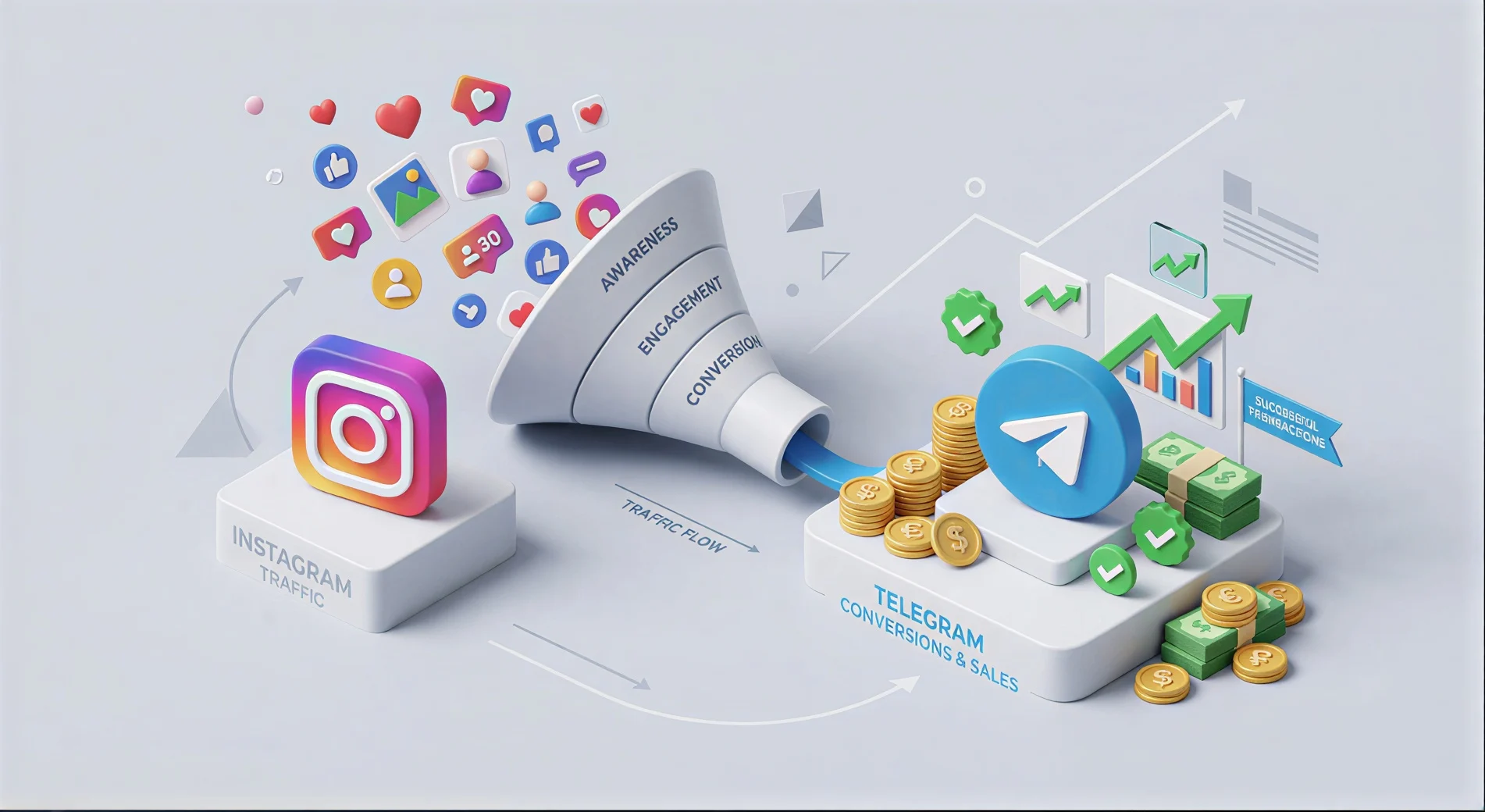
In 2026, Uzbekistan's retail industry is experiencing a crisis in traditional SMM: customer acquisition costs on Instagram are rising, while conversion rates are falling due to the long sales cycle on Yandex.Direct. This article is an in-depth analysis of an alternative: autonomous Telegram bots (Mini Apps). We analyze the shift in focus from reach to ROI (return on investment) using real numbers, compare the unit economics (CPL and CAC) of both platforms, and demonstrate how implementing a hybrid sales funnel helps businesses automate routine tasks and dramatically increase net profit.
The Illusion of a Beautiful Window Display: Why Likes No Longer Pay the Bills
Over more than 15 years of working in performance marketing, I've witnessed many stages of business growth. I remember the days when simply creating a social media page and posting mediocre product photos was enough to dramatically increase sales. Today, when I talk to local retail owners, marketing directors, and e-commerce project managers, I see the same silent weariness in their eyes.
Businesses invest colossal budgets in visuals, hire entire teams of creatives, rent studios, and generate hundreds of thousands of views. Everything looks amazing in the reports: reach charts are growing, users are liking and saving posts. But when the CFO balances the balance at the end of the month, a reasonable question arises: where's the money?
While working on increasing organic traffic and managing Google Business profiles for local businesses, whether it's Barbermatch or our large-scale projects at KelyanMedia, I've learned the hard way: any traffic you can't quickly and systematically convert into sales is a direct loss. And this is where the fundamental problem of choosing platforms for small and medium-sized retailers lies in 2026.
We find ourselves in a situation of total shift in focus. The era of vanity metrics is over. Today, quality SMM promotion in Tashkent It's not about the number of subscribers. It's about a tough, digitized unit economy, where return on investment (ROI) and ROMI (return on investment) are paramount. In this longread, we'll take off our rose-colored glasses and take a closer look at Uzbekistan's two main e-commerce ecosystems—Instagram and Telegram—to understand where marketing budgets are truly worth investing.
Instagram as a 2026 Showcase: Aesthetics, Algorithms, and Audience Burnout
Let's be honest: Instagram remains the most beautiful and emotionally engaging digital storefront of all. For the fashion industry, premium perfumes, jewelry brands, and beauty, this platform serves a critical positioning function. However, the way the platform operates "under the hood" has changed dramatically, and many entrepreneurs still live in the illusions of yesteryear.
Reach Algorithms: The Dictatorship of Recommendations
While Instagram used to be a social network (Social Graph) where people viewed content from their friends and followers, today it's an algorithmic recommendation feed (Discovery Graph). The platform is powered by machine learning, with one goal: to retain user attention for as long as possible.
- Reels - Cold Ocean: Short vertical videos have become the only free way to reach cold audiences (those who don't know you). But the Reels algorithm is ruthless. It analyzes Retention Rate (retention). If your video doesn't capture the viewer within the first second, it's immediately penalized in search results. Businesses are forced to transform into media companies: generating trends, writing scripts, hiring actors. This is no longer just "showing off a product"; it's a full-fledged production.
- Stories - a battle for loyalty: Stories remain a tool for engaging with a warm audience. But reach is declining. Users follow 500+ accounts, and to ensure they watch your stories to the end, you need to build complex storytelling. Commercial accounts that simply post "10% Discount" banners are pushed to the very bottom of the impression queue by the algorithm.
The Challenges of Targeted Advertising: Why the Auction Is Burning«
When people come to me for a consultation and ask why Instagram promotion in Uzbekistan: price became so high, I explain the mechanics of the Meta auction.
The platform's inventory (the number of ad placements) is limited, and the number of businesses wanting to display their ads is growing exponentially. As a result, we're seeing a systematic increase in CPM (Cost Per Mille – cost per thousand impressions).
Furthermore, global privacy policy changes (starting with iOS 14+) have seriously impacted the accuracy of microtargeting. Meta increasingly relies on broad audiences and its internal Advantage+ algorithms, which requires advertisers to invest more in the machine learning stage. If you don't have the budget for testing, you're simply wasting money on the algorithm.
The Deal Cycle: From Warm Interest to the "Direct Curse"«
The biggest pain point for Instagram stores is the closing process. Building a content funnel is only half the battle. The real drama unfolds in Yandex.Direct.
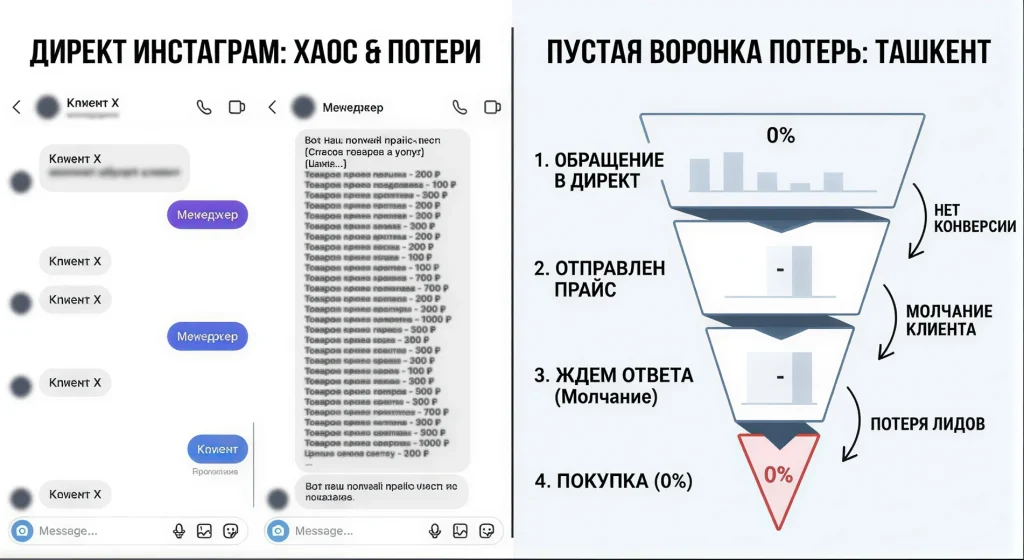
Imagine a customer seeing stunning Reels featuring your product while lying in bed one evening. The emotional impulse compels them to write: «"How much does delivery to the center cost?"».
And then begins what I call the «risk zone»:
- The manager is sleeping (or busy with another client). No answer.
- In the morning the manager answers, but the client is already at work and has no time for shopping.
- The client returns to the correspondence in the evening and asks about the sizes.
- The manager sends a long text price list or asks you to follow a link to an external site that takes a long time to load.
- The momentum is lost. The client switches to competitors.
Businesses are losing up to 60% of warm leads simply due to human error and the lack of instant, seamless payment infrastructure.
Hidden production costs that are not being talked about
When calculating profitability, we can't just factor in the platform's advertising budget. Maintaining a high-quality Instagram store in 2026 requires a huge payroll.
| Hidden cost item | Impact on unit economics |
| SMM team (In-house or Outsourcing) | Salary for storyteller, reels maker, copywriter, and designer. |
| Visual production | Regular rental of photo studios, payment of models, stylists, photographers. |
| Sales Department (Direct Managers) | The need to hire 2-3 people to work in shifts 24/7 to avoid losing leads. |
It is this financial burden that forces systemic entrepreneurs to seek alternatives.
Telegram Bots as an Autonomous Sales System: The Era of Engineering and Automation
Just the other day, during our weekly project documentation review with Alena Bondareva, we took a detailed look at the sales funnel of a major regional retailer. The situation was classic: Instagram was generating traffic, but Yandex.Direct was suffocating, and conversion rates were dismal. The solution we implement in such cases has already become an industry standard: migrating sales to the Telegram Mini Apps (TMA) ecosystem.
For Uzbekistan, Telegram is no longer just a messenger. It's a SuperApp where people handle work-related matters, read news, and make purchases. In 2026, a "Telegram store bot" isn't a dull text menu with commands like /start and /catalog. It's a fully-fledged, stunningly beautiful web app that opens over the chat in a split second.
Modern store architecture in Bot
What happens when a customer enters such a bot? They don't leave the familiar messenger environment, but get the experience of a full-fledged online store.
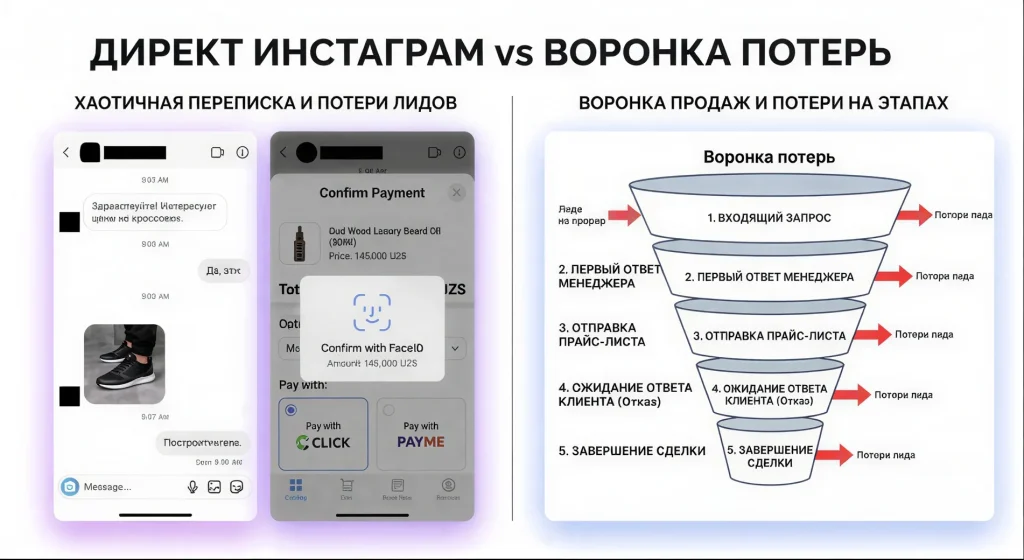
- Frontend (User Interface): The client sees an intuitive catalog. Swipes, color and size filters, reviews, and vibrant photos—everything works instantly because the interface is optimized for the Telegram engine.
- Cart and Checkout: The checkout process is streamlined to a minimum. The bot doesn't need to ask for a name or force the customer to go through a tedious registration process with email confirmation. The phone number the customer provides is used to retrieve all the necessary history in one click.
- Backend (Business Management): Beneath the beautiful interface lies a powerful architecture. The bot seamlessly connects to your warehouse CRM (e.g., MyWarehouse or 1C). Bought your last pair of sneakers at a brick-and-mortar location? They immediately get the "Out of Stock" status in the bot. No more "Oops, sorry, we're out of stock" situations that can cause customer frustration.
Deep Integrations: From Logistics to Payment Gateway APIs
Autonomy is what businesses pay developers for. A modern bot automatically leads the customer by the hand until they receive their receipt.
1. Financial Transparency (Acquiring)
We set up direct integrations with the APIs of local payment providers (Payme, Click, Uzum Pay).
How does it work for the client? They fill their shopping cart, click "Pay," and the bot generates a dynamic invoice directly in the chat. The client taps FaceID/TouchID, confirms the payment in the banking app, and the system instantly updates the order status. There's no longer any need to ask clients, "Please send a screenshot of the transfer to the card." It's a transparent, legal, and scalable model.
2. Logistics without human intervention (Delivery)
Integration with courier services via API (for example, Yandex Go Delivery).
When a customer places an order, they submit their geolocation (click the button in the interface). The system automatically calculates the distance to your warehouse and provides an accurate delivery cost based on the aggregator's rates. After payment is confirmed, the bot automatically calls the courier, generates a delivery note, and sends the customer a tracking link. The manager doesn't even need to open the chat.
Automatic Follow-Up Emails: A Retention Goldmine
The most expensive mistake in retail is paying to acquire a customer and letting them leave after their first purchase or abandoned cart. On Instagram, remarketing costs money. On Telegram, a bot's database is your digital asset, accessible for free.
- Abandoned Cart Scenario: The client added a dress to their cart, but was distracted by a call from their boss and closed Telegram. After three hours, the bot will send a soft notification: «"Hello! Your order is almost complete. Your dress size is reserved for 24 hours. Need help choosing?"». This simple automation returns up to 25% of "lost" money.
- Cross-sell: A person bought a coffee machine. The bot remembered the date. Three weeks later, the bot sends a message: «"We hope your coffee machine is bringing you joy in the morning! It's time to replenish your beans. Get a 10% discount on fresh roasts."».
- Effortless segmentation: The system automatically divides your database into VIP clients (those who purchase frequently and frequently) and "dormant" clients (those who haven't visited in a while). You send targeted emails with personalized offers. And best of all, the cost of sending these messages is zero.
Unit Economics: Comparative Analysis of CPL and CAC
Let's put emotions aside and get down to the dry math. As a professional smm agency Tashkent, We require our clients to think in terms of the cost of a target action, not the number of reactions to stories.
Two key metrics that determine the viability of your business are CPL (Cost Per Lead) and CAC (Customer Acquisition Cost).
Anatomy of metrics
$$CPL = \frac{Budget\ for\ marketing}{Number\ of\ leads\ received}$$
(A lead on Instagram is a Direct message. A lead on Telegram is a bot launch.).
$$CAC = \frac{Budget\ for\ marketing\ +\ Costs\ for\ sales\ department}{Number\ of\ new\ customers}$$
(CAC shows how much real money you spent to get cash from a new customer in the register.).
Comparative analysis using 1,000 leads as an example
Let's simulate a real-world market situation. We have a budget of $1000, and we've purchased traffic (on Instagram via targeted ads, on Telegram via Telegram Ads, or via seeding). Let's say we received 1000 leads in both cases (CPL = $1). What happens next?
| Sales Funnel Stage | Scenario 1: Instagram (Manual processing in Yandex.Direct) | Scenario 2: Telegram Bot (Automation via TMA) |
| Incoming flow (CPL = $1) | 1000 Direct requests | 1000 bot launches |
| Stage 1: Response Speed | 750 people waited for a manager's response (25% left due to waiting) | 1000 people instantly saw the catalog |
| Step 2: Selecting a Product | 300 people continued the conversation and selected the product. | 450 people conveniently filtered products and created a shopping cart |
| Step 3: Payment (Checkout) | 150 people requested bank details. Half of them disappeared (you have to go to the bank's app, transfer, and upload a screenshot). | 350 people proceeded to payment. The bot automatically reminded those who forgot. The Click/Payme integration works seamlessly. |
| Total new clients: | 75 clients | 315 clients |
| Overhead costs (Sales) | The salary of two managers to process 1000 leads = ~$500 | Server and bot API maintenance = ~$50 |
| Final CAC calculation: | $$(\$1000 + \$500) / 75 = \$20$$per client | $$(\$1000 + \$50) / 315 = \$3.33$$per client |
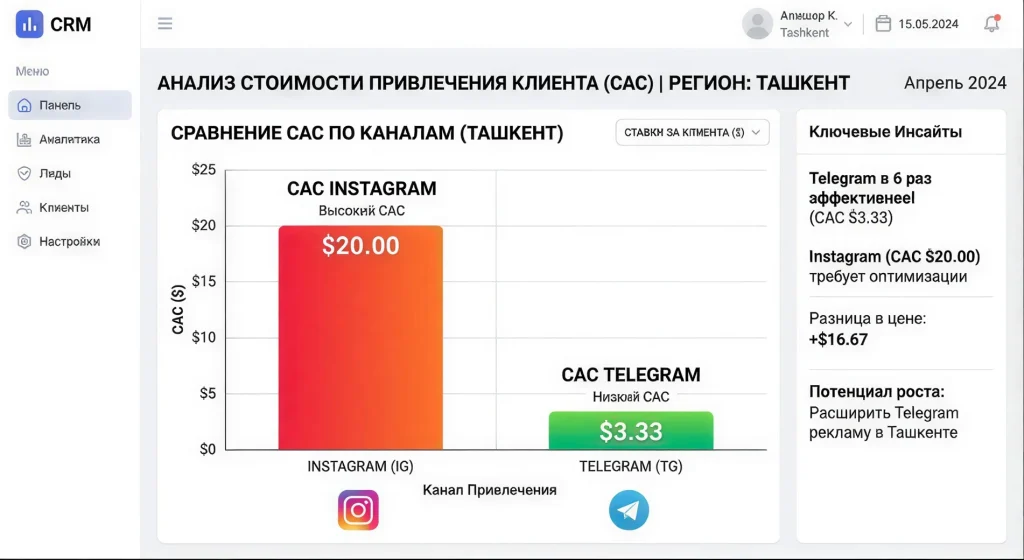
Expert's conclusion: Take a close look at these numbers. A lead on Instagram may seem inexpensive at the start. But due to colossal losses at every stage of manual processing, the final cost per paying customer (CAC) skyrockets. Automation in Telegram reduces losses at every step of the funnel, making the customer significantly cheaper for the business.
LTV (Lifetime Value) on both platforms: Where does the customer buy most often?
Attracting a customer is only half the battle. The real profit in e-commerce lies in repeat sales. LTV (Lifetime Value) is the total revenue a customer generates over the entire period of their interaction with your brand.
$$LTV = Average\ check \ times Frequency\ of purchases \ times Lifespan\ of a client$$
Differences in approaches to retention
- The LTV Problem on Instagram:
Once someone buys a bag from you, they leave Yandex.Direct. To sell them a second bag six months later, you need them to see your post. But algorithms are merciless: if they don't like your ads every day, they'll stop seeing you in their feed. Bottom line: to make a repeat sale, you re-run targeting and pay for the same customer again. Your margins dwindle. - LTV's triumph on Telegram:
A Telegram bot is essentially your own loyalty app in your customer's pocket. People don't delete the bot after a purchase (they simply "mute" it, turning it off, which is perfectly fine).
- When you release a new collection, you send out a push notification directly to your database.
- The bot has a built-in cashback system. The customer sees: "You have 50,000 soums in your account, they will expire in 7 days." This is a powerful trigger for repeat purchases.
As a result, the Purchase Frequency in a properly configured Telegram bot is historically 40-70% higher.
Synergy (Hybrid Approach): Not "Or", but "And"«
Often, after such analysis, clients ask, "Does this mean we should completely delete Instagram?" No. This is extreme thinking, which is detrimental to business. The highest ROI lies in the synergy between the two platforms—we call it the Hybrid Approach.
The job of a sales funnel architect is to leverage each site's strengths while compensating for their weaknesses.
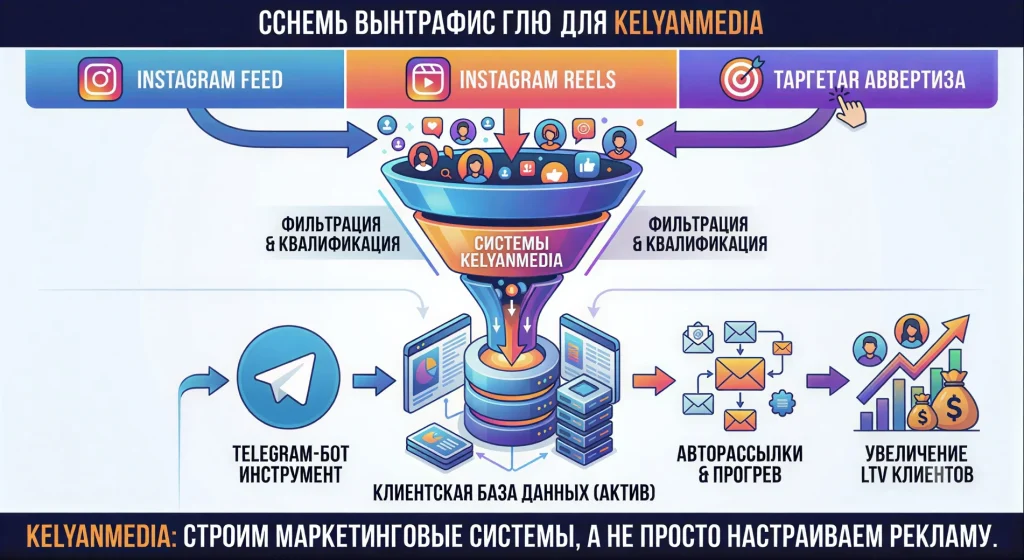
Instagram = Top of the Funnel
We use Instagram exclusively to generate demand and create visual desire.
- Here we shoot creative Reels to reach a cold audience.
- Here we buy advertising from bloggers (influencers), showing the product in real life.
- But we We don't try to sell in Yandex.Direct..
Telegram = Middle & Bottom of the Funnel (Conversion and Retention)
Once a user has shown interest, our task is to immediately transition them to Telegram's controlled environment.
- In Meta's targeted advertising, we place a deep link directly to the Telegram bot launching the desired catalog, rather than a website link.
- In response to any reaction in Yandex Direct (configured autoresponder), the client receives a message: «"We're glad you liked it! Check current size availability, prices, and free shipping estimates in our bot. Get 10% off your first order through the bot: [Link]"».
In this model, Instagram functions as a powerful, beautiful billboard on the highway, and the Telegram bot is like a trained, perfect salesperson-cashier who works 24/7 without lunch breaks, taking traffic from the highway and turning it into money.
KelyanMedia Expertise: We don’t just «cut posts»
The digital services market in Uzbekistan is oversaturated with offers for beautifully designed feeds. But to survive in 2026, retailers need more than just aesthetically pleasing images. They need a transparent digital ecosystem.
At KelyanMedia, we approach marketing like business architects. We rely on rigorous analytics and data. Our expertise extends beyond creativity:
- End-to-End Analytics: We connect all touchpoints. You'll see on the dashboard which specific Instagram ad campaign brought in a customer who, three weeks later, purchased a product from a Telegram bot.
- Mini Apps Development: Our technical specialists design and implement web apps of any complexity, integrating them with your warehouse software and payment gateways. We ensure your system runs like a Swiss watch.
- Remarketing automation: We develop triggered email marketing logic that engages hesitant customers and re-engages those who abandoned their carts, maximizing your LTV.
We combine the visual power of social media with the engineering precision of messaging apps to generate net profit for your business.
