


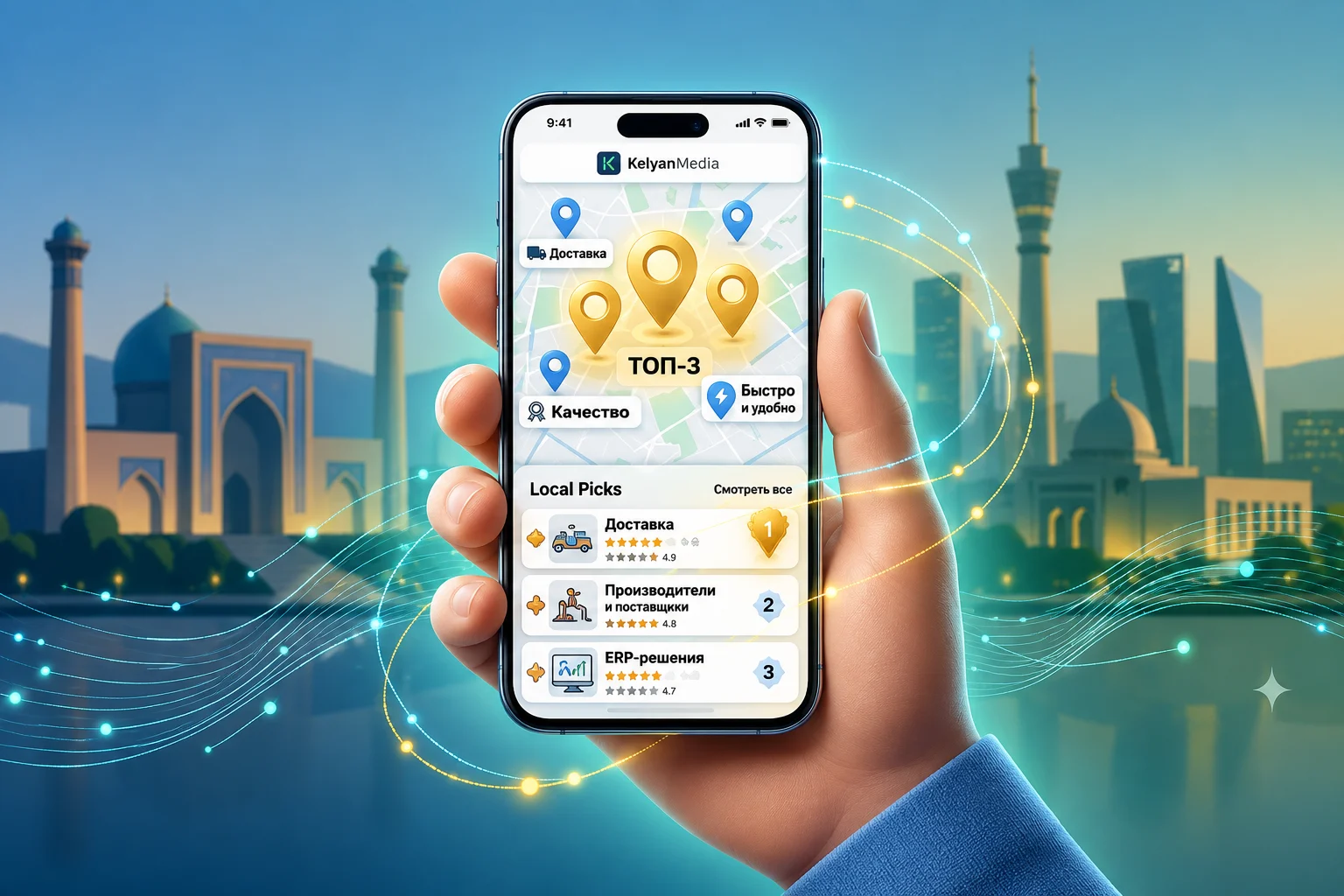
In 2026, the battle for local traffic in Tashkent shifted from traditional search results to maps. A top-3 Local Pack ranking in Google Maps and Yandex Business generates up to 651,000,000 commercial inquiries without direct costs for contextual advertising. The study examines local ranking algorithms (Proximity, Relevance, Prominence), EXIF metadata optimization methods, SERM mechanics, and geo-visibility monitoring technology using Geo-Grid heatmaps.
1. What's Really Happening with Search Traffic in Tashkent
Let's take a moment to look at the phone of an ordinary Tashkent resident or visitor. Imagine a typical life situation: someone has a severe toothache, urgently needs an MRI, needs to find a 24-hour pharmacy with a rare drug, or needs to choose a decent restaurant for a business dinner with partners on Mirabad.
How does he handle his smartphone? He doesn't open his laptop, doesn't type abstract queries, and certainly doesn't scroll past the second or third page of Google's organic search results to read long articles.
He enters a query with an instant geomarker («MRI 24 hours», «premium restaurant near me», «Yunusabad pharmacy») and immediately looks at the map.
In 2026, the blocks Local Pack (the top three spots on Google Maps) and the Yandex Maps widget take up up to 85% of the smartphone's top screen. Regular websites are pushed far down—they're simply not scrolled to. The user sees three cards, checks ratings, reads recent reviews, and taps one of three basic buttons: "Directions," "Call," or "Book.".
If your business isn't in the top three on the map, you don't physically exist for the 70% clients with "hot" money in your area. They'll go to the competitors who have taken over those top three spots.
Map promotion in Tashkent has long outgrown the simple "address entry" format. It's a standalone, highly converting sales channel. Conversion rates from map views to actual calls or visits reach 8-14%. By comparison, traditional contextual advertising or targeted social media advertising can only dream of such a metric, while the cost per click in paid advertising in Tashkent is increasing every quarter. Local SEO has become the most cost-effective tool in terms of return on investment (ROMI).
2. Anatomy of Algorithms: How Google and Yandex Raise Cards to the Top 3
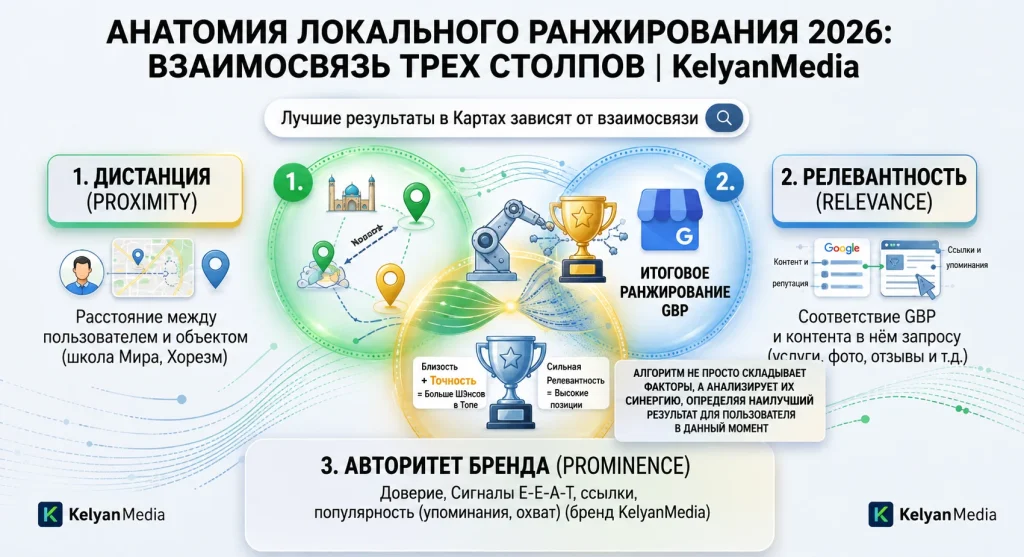
Local search isn't magic or "luck." It's a mathematical model that analyzes hundreds of signals. Both Google Maps and Yandex Maps rank businesses based on three fundamental pillars:
- Proximity (Physical distance): The distance from the client's smartphone to your door at the time of the search.
- Relevance: How accurately do the categories, price lists, and keywords in your card match what the user entered?.
- Prominence (Fame and Authority): The volume and quality of your reviews, the activity of your card, and the authority of your main website on the web.
What is the fundamental difference between Google Maps and Yandex Maps?
As a specialist who manages card networks, I can say right away: setting them up identically is a mistake. The platforms have different philosophies:
- Google Maps is fanatically committed to the Proximity factor: Google's search engine rigorously compresses its search results. If someone searches for a clinic in Chilanzar, Google will show them facilities within a 1-2 kilometer radius. Even if a clinic on the other side of town has thousands of perfect reviews, Google will prioritize the one closest to them.
- Yandex Maps values CTR and behavioral factors: Yandex is more flexible. It's willing to show a restaurant or pharmacy within a 5-7 kilometer radius if it sees that users regularly click on the card, navigate to it in Yandex Navigator, and actively interact with the content.
Analysis of algorithmic matrices
| Ranking factor | Google Maps (Google Business Profile) | Yandex Map (Yandex Business) |
| Proximity factor weight | Extremely high. The algorithm compresses the search radius to 1–3 km from the user. | Moderate. Yandex is willing to show objects within a 5-10 km radius with a good CTR. |
| External SEO Domain Accounting (EEAT) | Direct correlation with the main website's ranking. Domain Trust (DR) directly impacts rankings. | Indirect influence. Priority is given to internal factors and priority placement. |
| Analysis of review semantics | Neural network analysis of LSI keys and entities within review texts. | Direct search for keywords in reviews, taking into account ratings by criteria (service, prices). |
| Behavioral factors (User Signals) | Clicks on the phone, route planning, and photo views are taken into account. | A critical factor. The card's CTR and the frequency of trips through Yandex Navigator drive it up. |
| Commercial attributes and price lists | Filling out the menu and services increases relevance for specific queries. | End-to-end indexing of products and services. The presence of prices and the booking button directly influence the top results. |
EEAT (Expertise and Trust) Factor
By 2026, algorithms had finally learned to recognize fakes and dummies. If you run a medical center or a pharmacy chain, you won't get to the top rankings just by having pretty photos. Algorithms check for links to specific doctors' profiles and their experience, scans of their Ministry of Health licenses, the company's official website, and certificates.
In the premium HoReCa segment, algorithms evaluate chef mentions in restaurant guides, brand history, and industry publications. The more digital evidence of your real expertise is available online, the more likely mapping services are to recommend you to users.
3. Multimodal Content: How to Make Algorithms Love Your Card
Simply entering your business name, clicking the "Sign up for Google Business" button, entering your phone number and business hours—in 2026, that's probably enough to get you found by your actual name. To rank for competitive queries and steal someone else's traffic, you need multimodal content.
Search engines have long since ceased to be mere "text readers." They've learned to view photographs and virtual tours just like humans.
1. Optimizing EXIF data in photos (GPS tags)
Google and Yandex's Computer Vision automatically scans uploaded photos. Robots recognize what the image depicts: a dish, an operating room, a shelf full of medications, or smiling staff.
But the main secret to professional GEO promotion lies in EXIF (Exchangeable Image File Format) metadata. When we photograph objects for our clients, each photo file is embedded with physical geotags (WGS84 latitude and longitude coordinates), date, time, and shooting parameters.
When a bot scans such a photo, the embedded GPS coordinates serve as mathematical proof that the photo was taken at that exact location in Tashkent. This dramatically increases the card's credibility and protects it from bans for using online stock photos.
2. 360° 3D tours and virtual panoramas
Integrating spherical panoramas keeps users on the card for an average of 40-60 seconds longer. For algorithms, this is a powerful behavioral signal: «"The user is glued to the card, studying the interior—that means the property is high-quality, it needs to be promoted."».
- In restaurants (HoReCa): A 3D tour allows clients to step inside and appreciate the privacy of the VIP rooms, the spacing between tables, and the atmosphere, alleviating the anxiety of booking an important meeting.
- In clinics and MRI centers: The panorama shows perfect sterility, comfortable waiting areas and modern medical equipment (for example, a brand new MRI scanner), reducing patient anxiety.
- In pharmacies: The virtual tour demonstrates an open display, a wide range of products, and the presence of specialized departments (orthopedics, medical cosmetics).
3. Regular publication and filling of price lists
In 2026, cards became micro-social networks. If you publish short news items, promotions, or special offers with action buttons ("Book," "Call") once a week, the system sees that your business is actively operating. Such cards receive up to 35% more organic impressions.
Additionally, we always maintain price lists for 100%. Each service or medication must be described with LSI keywords. When a user searches for "knee MRI 3 Tesla price Tashkent," Yandex and Google retrieve our clinic listing precisely because of our completed price list.
4. SERM as a Controllable Factor: How to Get the Most Out of Reviews
Reviews on maps are no longer just a tool for stroking one's ego. They're a strict algorithmic ranking factor.
Natural language processing (NLP) algorithms scan review texts for keywords. When your customers write in restaurant reviews: «"We had a fantastic ribeye steak and burrata salad, and the service was excellent."», The algorithm indexes these words. And when someone else searches for "best steak in Mirabad," Google will rank your establishment based on the keywords in the reviews.
Tashkent's niche-specific SERM (SERM)
| SERM indicator | HoReCa (Premium Restaurants) | Medicine (Clinics/MRI) | Retail (Pharmacy chain) |
| Target rating for TOP-3 | 4.7 – 4.9★ | 4.8 – 5.0★ | 4.5 – 4.8★ |
| Critical factor in reviews | Mention specific dishes, the work of the waiters, the atmosphere. | Full names of specific doctors, accuracy of diagnoses, politeness of staff, absence of queues. | Availability of drugs in stock, pharmaceutical consultation, speed of service. |
| Frequency of review updates | 3-7 new reviews per day per location. | 2-5 new reviews per day per branch. | 5-12 new reviews per day per network. |
| Rules for responding to negativity | Up to 2 hours. A response from the manager offering a gift. | Up to 1 hour. Official response from the quality service with a proposal to investigate the case. | Up to 3 hours. Customer service response with receipt number clarification. |
The golden rule of processing negativity: You're not responding to a bad review to convince an angry reviewer. You're responding for the thousands of potential buyers who will be reading this conversation tomorrow, and for the search engines evaluating your credibility and customer service.
If you have a rating of 4.2, you're at risk. Cards with a rating below 4.3 are automatically penalized by algorithms and drop out of the top three for high-frequency commercial queries.
5. Geo-Grid: How we see your business through the eyes of algorithms
Ordinary marketers check a company's rankings simply by sitting in their office and typing search queries into their phone. This is absolute nonsense. In local marketing, your ranking changes every 300-500 meters. On the street in front of your door, you might be ranked #1, but around the corner, two blocks away, you're ranked #14.
To see the real picture, at KelyanMedia we use technology Geo-Grid (heat maps of local output).
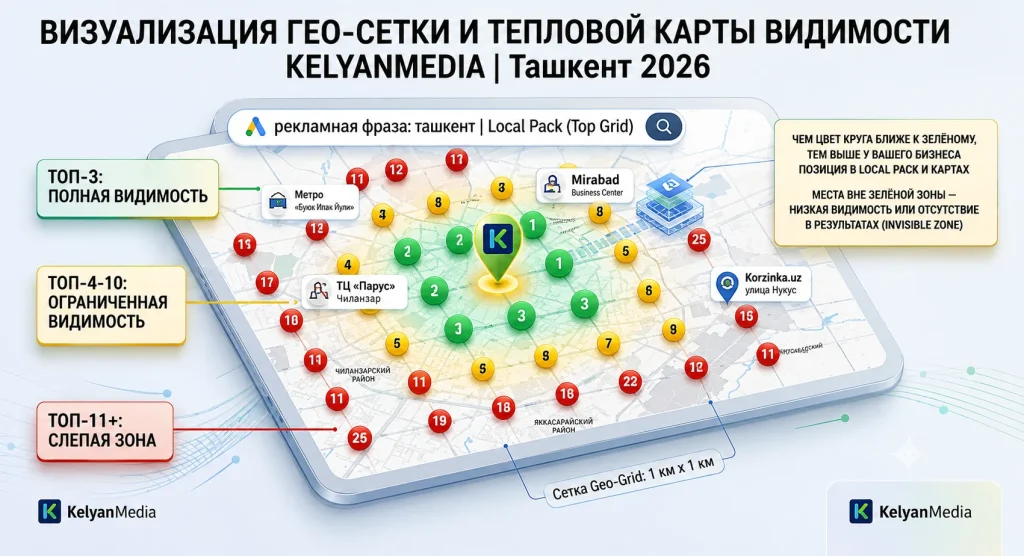
We overlay a virtual coordinate grid (for example, 9x9 points with a 500-meter or 1-kilometer increment) on a map of Tashkent and make emulated requests from smartphones at each specific node of this grid.
As a result, we get a visual color heat map:
- Green dots (1st-3rd place): Your zone of complete dominance. You take 80% of all clients from this quarter.
- Yellow dots (4th-10th place): Second-screen zone. Customers only see you if they expand the full list. You're losing up to half your traffic.
- Red dots (11+ place): Blind spot. In this area of the city, your business is invisible to smartphone users.
Geo-Grid's heat map instantly reveals weaknesses: we see precisely which districts in Tashkent are under pressure from competitors and target them with targeted local factors.
6. KelyanMedia System Analysis: How We Build a GEO Monopoly
Achieving and maintaining a top-three position on Tashkent maps isn't a one-time adjustment, but an ongoing engineering process. At KelyanMedia, we cover the entire local marketing chain:
- Fundamental optimization and cleaning: We find and remove duplicates of your company's cards (often created by users themselves), correct errors in categories, add EXIF metadata to photos, and integrate 3D tours.
- Automated Feedback Collection (Smart Feedback Systems): We're implementing NFC kiosks, QR codes, and integrations with Telegram bots at our points of sale. When a customer is satisfied, the system gently prompts them to leave a review on Google Maps or Yandex Maps. If the customer is dissatisfied, the system forwards their complaint directly to your manager before the negative feedback reaches the internet.
- Centralized network management (for retail and pharmacies): If you have 20 branches in Tashkent, managing them manually is impossible. We connect the Yandex Business and Google My Business API consoles, ensuring synchronized updates of prices, promotions, and contacts across the entire network.
- Protection from competitors' spam attacks: Unfortunately, unfair competition is common in Tashkent. If competitors start attacking you with bots, skewing your rating, or sending mass complaints that your business has "closed," our specialists and lawyers, through direct arbitration support channels, will promptly remove the false information and restore your rating.