



1. The Illusion of Independent Channels: How Businesses Buy Their Own Traffic
The classic approach to internet marketing, which has dominated the Uzbek market for the past five years, was based on a delegation model. A business leader would hire one agency to handle contextual advertising in Google Ads, a separate contractor for search engine optimization (SEO), and an independent freelancer for targeted advertising. Each of these professionals operated in their own vacuum.
From a business perspective, this is a disaster. When channels aren't linked by a unified strategy and end-to-end analytics, advertising budget cannibalization occurs. A PPC specialist, eager to present a sleek report with a low cost per lead (CPL), launches ad campaigns for your own branded search queries. Meanwhile, your website is already ranking first in organic SEO results for these queries. As a result, you're paying the search engine for clicks that customers would have gotten for free anyway. Your budget is spent not on attracting new audiences, but on repurchasing your own organic traffic.
Performance marketing disrupts this system. In 2026, marketing will be measured not by abstract "clicks" or search rankings, but by the cost of acquiring a paying customer (CAC) and the return on marketing investment (ROMI).
To ensure synergy between channels, it's essential to build a full-funnel architecture. In this paradigm, each tool performs a specific function at a specific stage of customer maturation. To illustrate, we'll examine the physics of this process using three highly complex niches with long decision-making cycles: premium development, wholesale B2B manufacturing, and automotive retail.
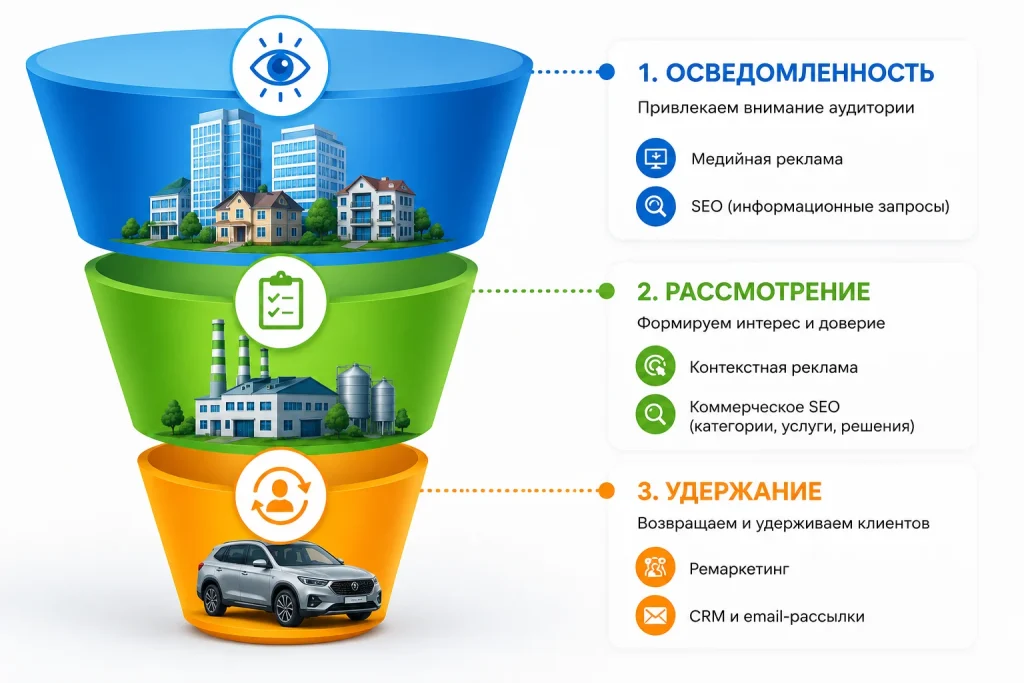
2. Full-Funnel Architecture: Integrated Sales Engineering
A user never buys an apartment, wholesale rebar, or a new SUV after clicking a single ad. The sales cycle in such niches lasts from several weeks to a year. Marketing must accompany the user every millimeter of this journey.
2.1. Top of the Funnel (Awareness and Need Formation)
At this stage, the client isn't ready to spend money yet. They're just beginning to think about the need to solve a problem. If you try to sell them a product right now with an aggressive "Buy at a discount" offer, they'll close the page. This is where display ads and deep informational SEO come into play.
Real Estate (Premium Residential Complex Developers):
An investor or future resident begins by researching the market. They read macroeconomic reports, study the ecology of Tashkent's districts, and plan their budget. The developer's task at this stage is to capture their attention through high-quality content. Informational SEO drives traffic to articles on the developer's blog: "Comparison of Commercial and Residential Real Estate Profitability in Central Tashkent" or "What Earthquake Resistance Technologies Are Used in New Buildings." At the same time, media advertising is launched with image renderings of the future building's façade, targeting top managers and business owners. The goal is to ingrain the brand in the client's mind.
B2B Manufacturing (Building Materials Plants):
In the heavy B2B segment, decisions are made by design engineers, estimators, and purchasing directors. Information SEO here is built around technical expertise. The plant publishes tables of mixture consumption rates, GOST standards, regulatory documents, and downloadable DWG drawings of components. When a chief engineer searches for concrete pouring regulations at subzero temperatures, he is directed to the plant's portal. This builds professional trust in the company as a reliable technical partner.
Automotive business (Official dealerships):
Car selection begins with watching video reviews and reading test drives. Users compare hybrid systems with traditional internal combustion engines. At this stage, authorized dealers launch comprehensive video campaigns (on YouTube and local platforms), demonstrating the car's performance on Uzbek roads or in mountainous terrain. Informational SEO addresses queries on maintenance costs, fuel consumption, and trunk space.
2.2. Middle of the Funnel (Demand Analysis and Interception)
Here, the client already knows exactly what they need. They begin comparing specific offers, prices, and terms. This is the zone of maximum competition, where commercial SEO and contextual search advertising work hand in hand for hot transactional queries.
Real Estate (Premium Residential Complex Developers):
A user enters Google queries like "buy a penthouse in the Mirabad district" or "premium residential complex Tashkent installment plan." Commercial SEO ensures the developer's website remains consistently visible in organic search results. At the same time, a contextual advertising (PPC) bid management algorithm is in place. If we see that our site is already ranked first organically for a specific query, the system lowers the bid to avoid cannibalizing free traffic. The freed-up budget is redirected to intercepting queries used by direct competitors.
B2B Manufacturing (Building Materials Plants):
A supplier is tasked with finding a supplier. They enter "M500 cement wholesale Tashkent price per ton" or "buy A500C rebar with factory delivery." In the B2B context, it's critical to use bid adjustments based on time of day and device type. Ads are broadcast during business hours (9:00 AM to 6:00 PM) with maximum priority for desktop computers, as purchases are made from offices. Commercial SEO ensures indexing of huge price lists, collecting low-cost, low-frequency traffic for hundreds of specific grades and diameters of rolled products.
Automotive business (Official dealerships):
Hot demand is reflected in search queries like "official dealer [brand] Tashkent prices" or "buy [model] on credit." The dealership's landing pages are optimized for instant conversion. Lead magnets include offering users the opportunity to download a detailed PDF price list with trim levels, use a loan calculator with integrated bank rates, or book a convenient time for a test drive in just two clicks.
2.3. Bottom of the funnel (Conversion, follow-up and LTV)
The biggest mistake inexperienced marketers make is thinking their work is done once they receive a click. Up to 951,000,000 users don't complete the desired action the first time they visit a website. If you're not working to re-engage your audience, you're simply paying for your competitors' advertising campaigns, which will likely convert the next day. At the conversion stage, dynamic remarketing and CRM systems come into play.
Real Estate (Premium Residential Complex Developers):
An investor visited the website, viewed the floor plan of a four-room apartment on the 12th floor, downloaded the presentation, but didn't leave a phone number. The system records this action. The next day, a banner featuring the exact floor plan they viewed starts appearing on news portals and social media. If contact is received but the deal stalls, targeted advertising is launched in Telegram Ads exclusively for the client's phone number. They are shown short videos featuring construction progress and news about price increases next month.
B2B Manufacturing (Building Materials Plants):
The key to a B2B plant's survival is repeat sales. We integrate marketing tools with the company's ERP/CRM system. If a developer purchases a batch of foundation blocks, the system calculates the approximate construction time for the walls. After six weeks, the marketing team automatically sends the decision maker a commercial offer for bricks or wall panels. B2B remarketing is aimed at retention: disseminating information about new quality certificates, expanding the delivery fleet, or upgrading production lines.
Automotive business (Official dealerships):
After a test drive, the customer's data is enriched in the CRM. If a purchase hasn't been made within a week, retargeting is launched for the "seen in the showroom, didn't buy" segment, offering a higher trade-in value for their old car. For those who have already purchased a car, a service funnel is built. Thirty days before the scheduled maintenance is due, the customer sees an ad with an oil change reminder and a special offer for loyal customers.
3. The Mathematics of Attribution: How to Track a Six-Month Customer Journey
When a deal lasts six months, a user has dozens of interactions with your brand. They read an SEO article, click on a contextual ad, click through from a Telegram channel, see a remarketing banner, and finally call the sales department directly, saving the number in their address book.
The problem with standard web analytics (Google Analytics by default) is the use of the attribution model Last-Click (By last click). With this approach, 100% of deal value worth hundreds of thousands of dollars is assigned to the last source. In our example, the system will show that the sale was generated by "Direct Entry.".
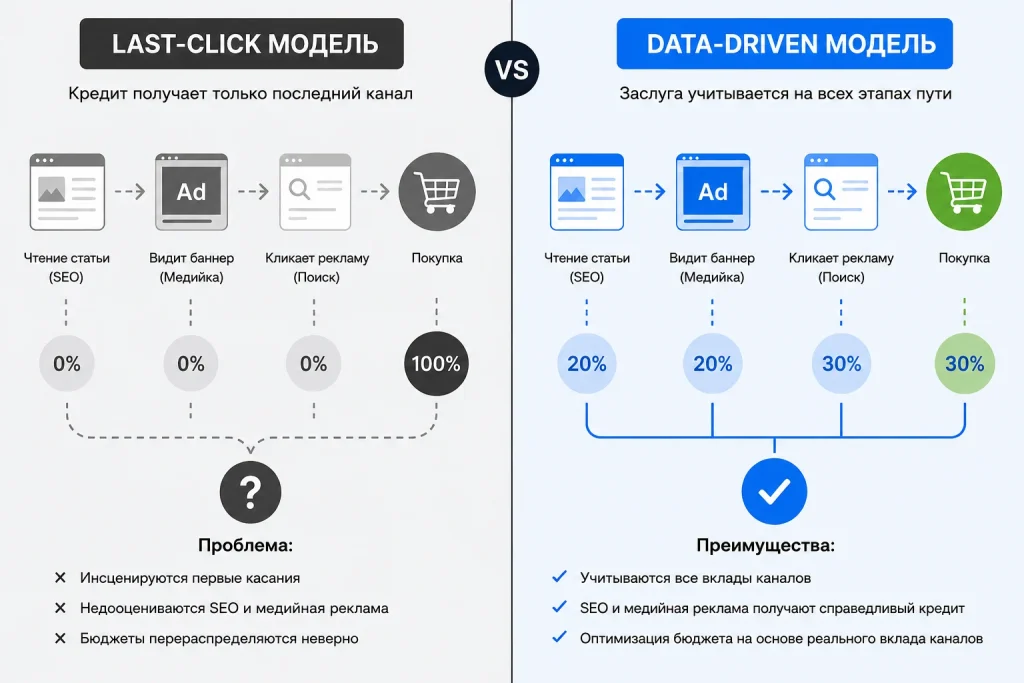
The manager looks at the report, sees that contextual advertising and SEO haven't generated any direct sales, and cuts off funding for them. Three months later, the customer flow stops completely, as the upper stages of the funnel have been destroyed.
Integrated marketing is impossible without setting up end-to-end business analytics systems.
Comparative analysis of attribution models for large businesses
| Attribution model | The logic of value distribution | Applicability in business niches | Critical risks |
| First-Click | 100% conversions go to the channel that first introduced the user to the brand. | Evaluating the effectiveness of outreach media campaigns and PR articles for new products. | Completely ignores remarketing channels and «pressure» tools, devaluing their work. |
| Last-Click | 100% values are given by the channel from which the user switched immediately before the call. | Fast sales, FMCG, food delivery with transaction cycles from 5 minutes to 2 days. | Absolutely unsuitable for real estate and B2B. Leads to fatal budget cuts. |
| Linear (Linear model) | Value is distributed equally across all channels along the user journey. | Niches with a medium transaction cycle, where constant nurturing of interest is important. | Equates the importance of viewing an image banner with an hour-long consultation in a website chat. |
| Data-Driven (Based on Machine Learning) | Neural network algorithms analyze millions of paths (successful and unsuccessful) and calculate the real weight of each touch. | Development, B2B factories, car dealerships. An ideal model for assessing return on investment. | Requires the setup of complex server analytics and perfect discipline in managing transactions in CRM. |
In KelyanMedia agency projects, we build an analytics architecture that integrates advertising accounts, a web analytics system, call tracking (call source tracking), and your corporate CRM. This allows management to see a clear picture of which specific search queries have paid off eight months after the first click.
4. Localizing Funnels: Cultural and Linguistic ROI Drivers
The most serious mistake when launching performance campaigns in Uzbekistan is the simple machine translation of Russian-language creatives into Uzbek. Uzbekistan is characterized by a complex bilingual content consumption pattern. The share of search queries in the state language is steadily growing, exceeding 75% in the regions and approaching 60% in the premium segment of Tashkent.
However, localization isn't just a translation of words. It's the adaptation of mental models and the linguistic architecture of sales.
Adaptation of meanings and landing pages
A copywriter's text without a deep understanding of local specifics will not convert traffic into leads.
Development: Concepts of individualism and European isolation, which work in Western markets, lose out to family values in Uzbekistan. When localizing landing pages for premium residential complexes into Uzbek, the focus shifts to the size of guest areas (mekhmonkhona), the appropriate zoning of spaces for large family gatherings, the safety of courtyards for children, and respect for neighborly traditions.
B2B Manufacturing: In the industrial sector, technical documentation, price lists, and certificates of conformity must be presented in two languages using correct construction terminology. For an Uzbek-speaking procurement engineer, it is critical to see familiar professional terms, rather than machine-translated text that undermines the manufacturer's credibility.
Automotive business: Buying a car in Uzbekistan is often a decision made with the input of older family members. Ads should convey reliability, status, a comfortable ride, and ample space for long trips. A slogan encouraging "aggressive solo driving" will result in a low click-through rate and a high bounce rate.
Localization of sales department scripts
The most expensive and high-quality lead from Google Ads is lost in 15 seconds if the call center agent can't communicate fluently, competently, and respectfully in the customer's language. The entire funnel collapses at the first touchpoint.
Sales scripts must be strictly bilingual. Initial call qualification should begin with determining the client's comfort level. Using appropriate national courtesy phrases when processing a test drive request or inviting them to the developer's sales office increases the conversion rate to appointments by 20-30%.
5. Marketing and Sales Synchronization: Why Leads Die in CRM
A fundamental conflict in traditional business is the line of responsibility between departments. A marketing agency considers its work complete after a lead is transferred to the CRM, while the sales department complains that the leads are "poor quality, unpaid, and don't even answer the phone.".
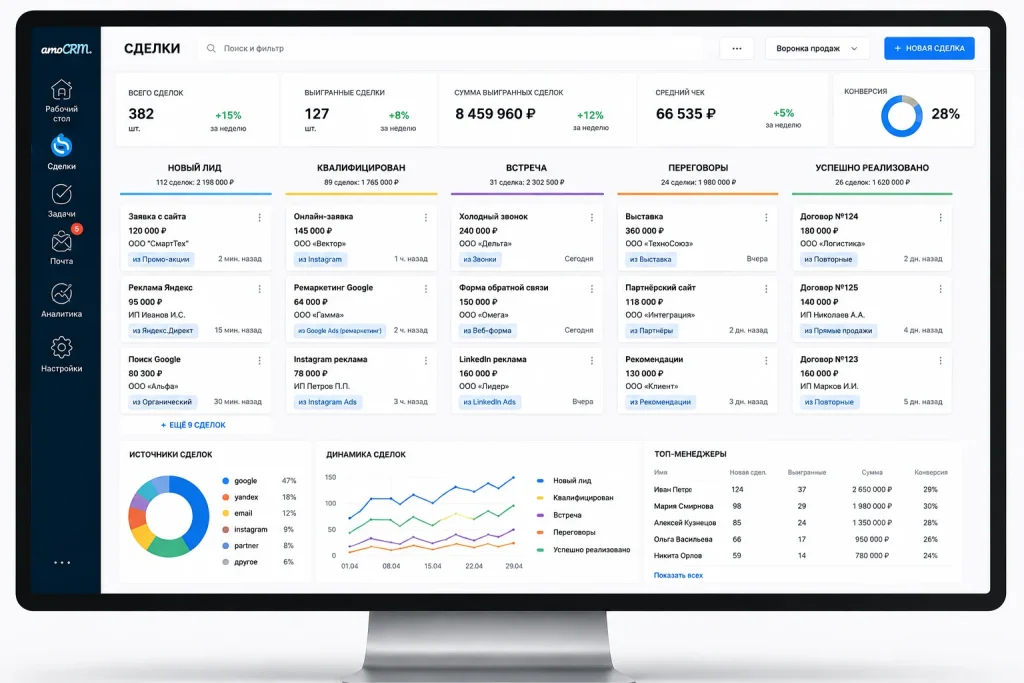
Integrated marketing is meaningless if the company's internal business processes aren't prepared to handle the traffic. High-quality leads are lost daily in sales funnels due to a lack of regulations. If a real estate manager calls a client back four hours after submitting a request on the website, the likelihood of closing the deal drops exponentially. In a tough B2B environment, a one-day delay in sending a rebar estimate is guaranteed to result in the loss of the contract—the client leaves for a faster competitor.
Before allocating budget to advertising channels, KelyanMedia conducts a rigorous audit of the client's sales department and CRM infrastructure.
Engineering audit of processes before launching traffic
- Implementation of SLA (Service Level Agreement): We establish a strict communication protocol. Marketing is obligated to deliver qualified leads (SQL) with a confirmed number and an identified need. The sales department commits to making the first contact with the client no later than 15 minutes after the card is marked as "New Lead.".
- Technical audit of CRM (AmoCRM, Bitrix24): We verify the seamless transfer of UTM tags, customer device data, and referral source data. Each deal card should contain a complete history: the keyword search that led the user to the deal, the banner they clicked, and how long they spent on the price list page.
- Setting up the scoring system (Lead Scoring): Automatic request prioritization saves managers time. If a client completes a detailed quiz on plant design, the system marks the lead as "Hot" and instantly transfers them to a Senior Sales Representative. If a client simply subscribes to a price list newsletter, they are sent to an automated Nurturing funnel without human intervention.
- Blocking false refusal reasons: Implementation of mandatory classification of lost deals. Managers can no longer reclassify deals as "Closed and not sold" with comments like "Client changed their mind" or "Too expensive." A strict classification system is being implemented: "Bank interest rate not acceptable," "No delivery to Surkhandarya," "Layout without balcony unsuitable." This data is automatically returned to the marketing department for immediate adjustments to advertising texts and targeting.
Only with absolute data transparency and synchronization between marketers and sales managers is a positive ROMI possible. The integration of SEO strategies, precise contextual advertising, deep remarketing, and localized funnels creates a closed ecosystem where every investment can be precisely mathematically controlled and scaled.