


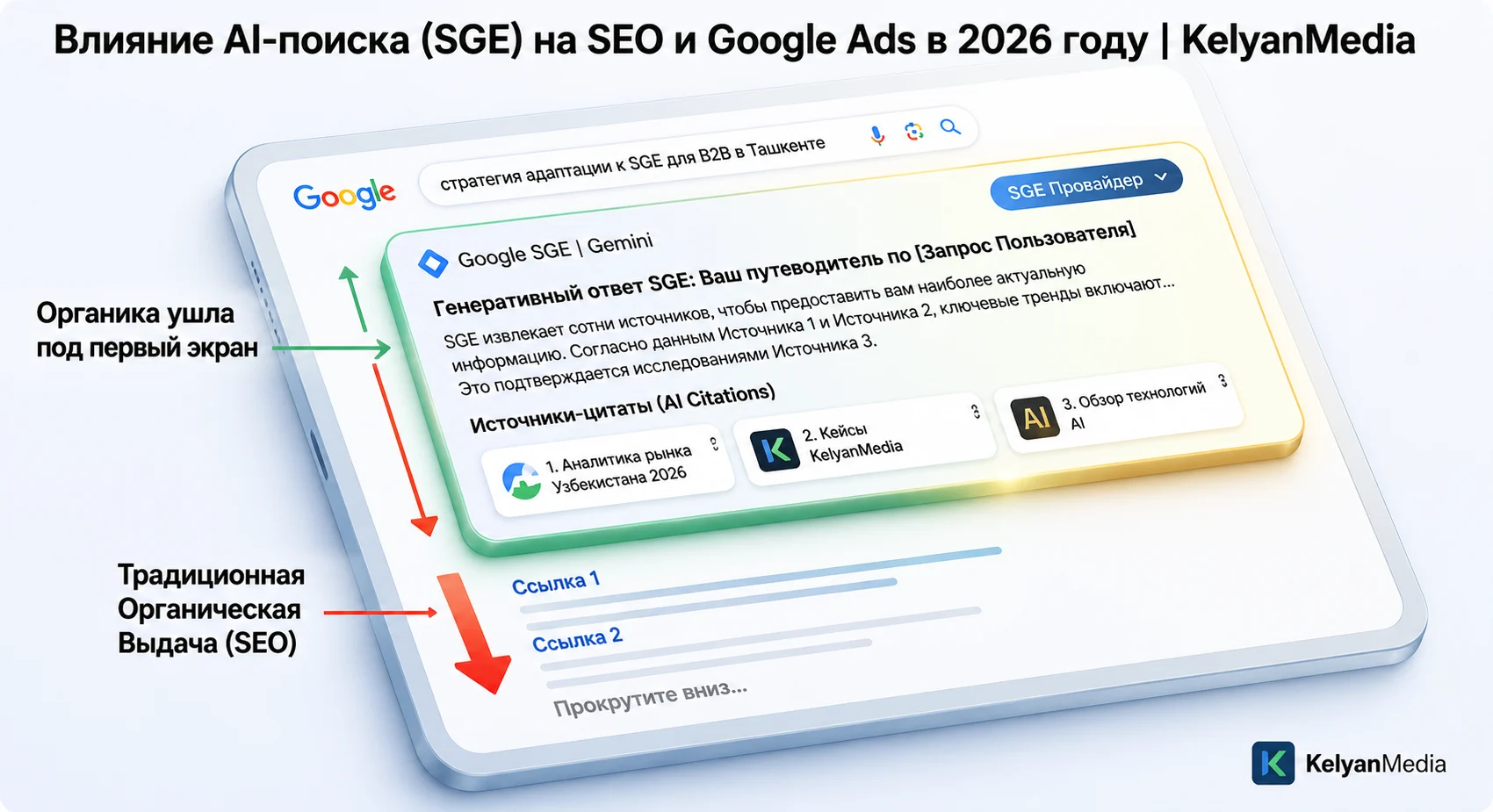
The integration of Search Generative Experience (SGE) and neural network responses in Google captures up to 60% of information traffic. For businesses in Uzbekistan, the 2026 strategy calls for a shift in focus to transactional queries, strict EEAT content validation, Schema.org markup, and deep integration of Performance Max in contextual advertising to capture this demand.
What Really Happened to Search and Why Old Methods No Longer Work
If you put aside the advertising slogans and look at the metrics, the situation is simple: classic search in the form we have become accustomed to over the past ten years is over.
Previously, a person would type in a query, open the first three or four websites that appeared, compare terms, and submit a request. Now, the first screen of a smartphone is completely taken over by an AI unit (Google's Search Generative Experience or Yandex's neural network response). The neural network itself collects data from dozens of websites, condenses it into a concise summary, and delivers the final result.
People get answers immediately on the search page. Analytics show this as an increase in Zero-Click Searches—situations where users don't visit external sites at all. Because of this, businesses lose between 401 and 601 percent of SEO traffic, which they previously spent years collecting through blogs and general articles.
But this doesn't mean SEO or contextual advertising are dead. Algorithms have simply purged superficial content from search results. The winners are those who provide not just "general information," but hard, practical expertise and direct access to purchases.
SEO Transformation: Why SEO Traffic No Longer Makes Money
When a user asks "how to choose an accounting system" or "what documents are needed for customs," the neural network answers the question directly in the search results. Trying to compete for these clicks now is simply a waste of budget.
The 2026 strategy is a complete transition to transactional SEO. If a client is looking for a specific service with a price, deadline, and guarantees in Tashkent, artificial intelligence won't replace a real contractor with a contract and infrastructure.
How does this work in practice in real niches?
1. B2B international freight transportation
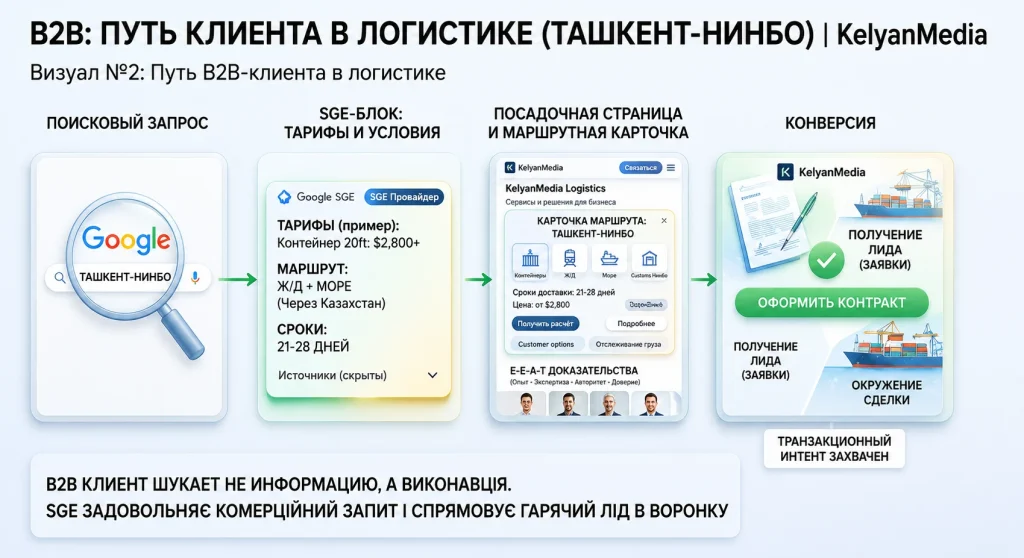
The neural network instantly returns information requests about Incoterms basic terms or cargo labeling rules. But when a major importer from Tashkent needs to import equipment from China, they're not looking for theory.
Logistics SEO is currently focused on specific areas, such as "container shipping from Ningbo to Tashkent with customs clearance." Here, users search for a specific carrier with a description of their fleet, estimated lead times, and actual customs clearance cases.
2. Corporate law and consulting
There's no point in asking a search engine for standard excerpts from Uzbek laws—AI can generate them in a second.
However, when a business faces redomiciliation, asset acquisition, or tax audits, no one will trust a neural network to manage the risks. SEO for lawyers has shifted toward analyzing real legal precedents, lawyers' personal brands, and resolving complex corporate cases.
3. SaaS solutions for business
General reviews and comparisons of programs "in general" no longer bring in customers. Users request specific features from AI tailored to their needs.
To capture this traffic, we optimize pages for clear business scenarios: "integrating a cloud cash register with a local ERP in Uzbekistan" or "automating warehouse management for distributors." The page should immediately display the interface, API documentation, and a clear pricing structure.
How user search behavior has changed
The difference between how SEO worked in the past and how it works now in the SGE system is easiest to see in numbers.
| Indicator | Classic SEO model | The Reality of SGE and AI Search (2026) |
| Main source of clicks | Blog articles, general reviews | Service pages, price lists, case studies |
| Average CTR of the first position | 28% – 35% | 11% – 18% |
| Zero-Click Rate | 25% – 30% | 50% – 65% |
| The main criterion for success | Top 3 by word list | AI response sources and conversion |
| User path to the application | 2–4 site clicks | 1 direct transition with a ready-made solution |
The EEAT Factor: Why AI-Generated Content Is Killing Websites
When the market was flooded with cheap texts from ChatGPT, Google and Yandex responded with drastic algorithmic updates. The main rule for 2026: if a text is written "about everything" and contains no traces of real, practical experience, the site will be immediately removed from the index.
Algorithms evaluate content according to the EEAT (Experience, Expertise, Authority, Trustworthiness) system.
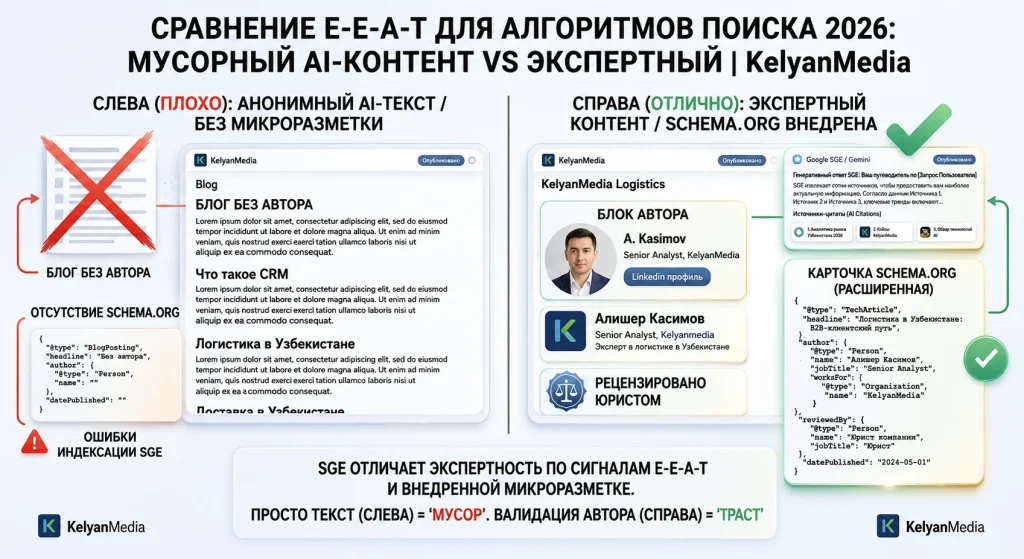
The main conclusion: Search engines need to see who's behind the text. An article about tax risks without identifying a specific lawyer, their practice, or legal references is perceived by search engines as just plain junk and won't even appear in regular search results, let alone in AI blocks.
What we do to confirm expertise on the site
- Real practical experience: The texts should contain things that a neural network can't come up with: real photos from facilities or warehouses, internal analysis of errors, and practical figures.
- The author's digital footprint: Each article is signed by a real company specialist. The search engine robot checks their profiles on professional networks, mentions on other resources, and media publications.
- Technical markup (Schema.org): To ensure the robot accurately links the author to the company, we use advanced microdata (TechArticle, Person, Organization). This is a direct signal to SGE that this website can be used as a primary source for generating an AI response.
Contextual Advertising (PPC): Automation and Operation within AI Blocks
Manual bid management in Google Ads is finally a thing of the past. Algorithms automatically decide who to show ads to and at what price, and the ad units themselves are now integrated directly into SGE's generative responses.
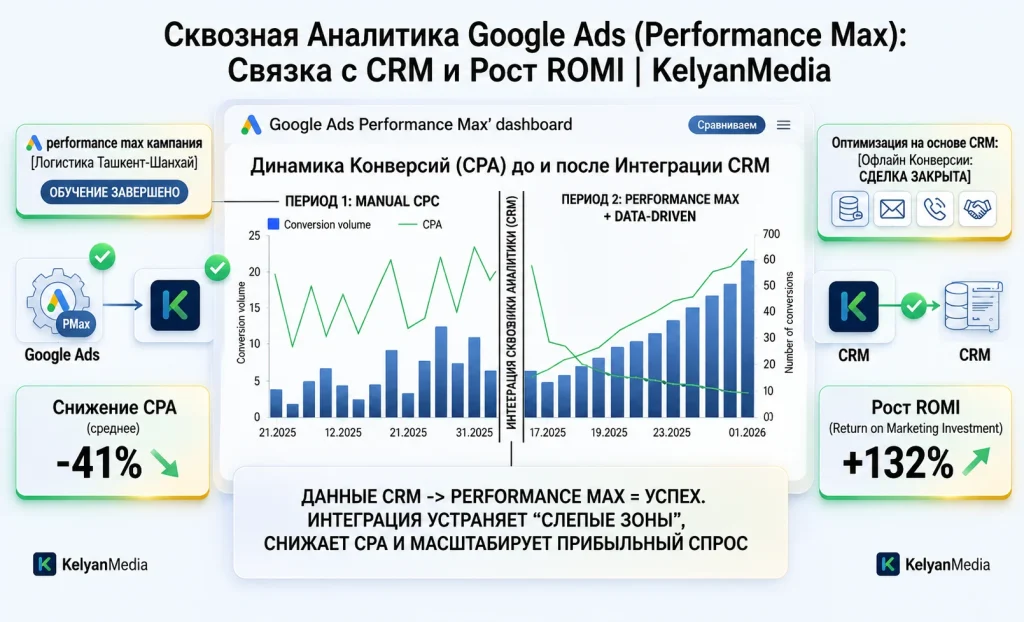
When a user asks a complex question, the AI model constructs a response and immediately inserts relevant sales cards. The primary tool now is Performance Max campaigns, which rely not on hard-coded keywords but on audience signals and user behavior.
Realistic cost benchmarks for the Uzbek market (2026)
- B2B International Logistics:
- Cost per click (CPC) in Google Ads: from $0.80 to $3.50.
- Cost per lead (CPL): $35 – $120.
- Strategy: Launch of Performance Max for decision-makers, with a focus on industrial zones and logistics hubs.
- Legal services for business:
- Cost per click (CPC) in Google Ads: from $1.20 to $5.00.
- Cost per lead (CPL): $50 – $180.
- Strategy: A targeted search for hot queries with landing pages tailored to a specific lawyer or practice area.
- SaaS and corporate software:
- Cost per click (CPC) in Google Ads: from $0.40 to $2.20.
- Cost to Acquire Registration (CAC): $15 – $45.
- Strategy: Optimizing bids for lifetime value (LTV) and engaging users in the demo version.
Rank Capture: The Link Between SEO and PPC
Nowadays, having separate SEO specialists and targeting specialists is a waste of money. With limited space in organic search results, the only way to win clients is to be present in all blocks above the fold simultaneously.
The logic is simple: if a person sees your ad above an AI block, then sees a link to your site in the AI response itself as an expert source, and then sees your site ranked first in a regular search, they will contact you.
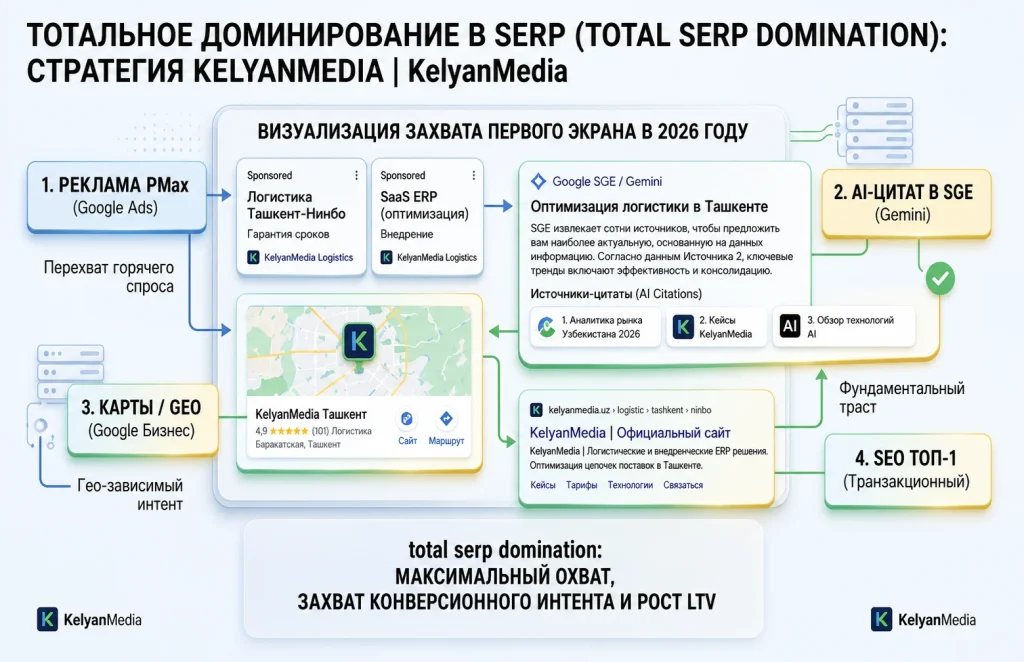
How tasks are distributed between channels
| Niche | What does SEO do? | What does PPC (Google Ads) do? | Result |
| B2B Logistics | Outputs pages to AI sources along specific routes; marks services using Schema.org. | Launches Performance Max on LPR and buys blocks in SGE. | Full presence on all commercial routes. |
| Jurisprudence | Expanding EEAT: lawyer profiles, analysis of ZRU laws, court cases. | Targeted search for high-value services (transaction support, disputes). | Maximum trust: the brand is visible both in advertising and in the expert AI block. |
| SaaS solutions | Optimizes pages for specific modules and technical integrations. | Scales campaigns based on the final cost per lead. | Reaching the buyer at all stages – from finding a solution to purchasing. |
KelyanMedia's Position: Comprehensive Business Adaptation to New Algorithms
At KelyanMedia, we don't just "buy links" or "write turnkey copy." We build a system that brings real money to businesses, measured by specific metrics: customer acquisition cost (CPA), return on advertising (ROMI), and customer lifetime value (LTV).
How we adapt your project to SGE
- Website audit for AI search requirements:
We'll check how algorithms currently view your site, whether Schema.org microdata is configured correctly, and what's preventing your pages from being included in AI snippets. - EEAT implementation:
We're revamping the website's structure and content: we're creating specialist profiles, adding evidence, case studies, guarantees, and real figures from your practice. - Setting up contextual advertising based on data:
We connect Google Ads with your CRM system. Advertising algorithms begin to look not just for clicks, but for people who actually buy. - Total SERP Management:
We combine SEO and contextual advertising into a single mechanism so you don't overpay for duplicate keywords and maximize your top-page traffic.