



In 2026, website development in Uzbekistan requires a comprehensive performance approach. The cost of a professional website in Tashkent ranges from 1,500 to 3,000 rubles for landing pages and corporate resources, and from 5,000 to 15,000 rubles+ for Highload E-commerce. The price is influenced by the choice of architecture (CMS or custom frameworks), the depth of UX/UI analytics, and integration with local payment systems (Payme, Click) and CRM (AmoCRM, Bitrix24). A fundamental difference between high-quality development and a mobile-first design, adapted to Uzbek consumer patterns, is a technical SEO foundation (Core Web Vitals, microdata) built in from the start.
Why your old website won't work in 2026
Let's face it: Uzbekistan's digital landscape has changed irrevocably. While just a few years ago, having even a small website was considered a competitive advantage, today it's a basic hygiene requirement that doesn't generate a single cent. Over my 15 years in SEO and digital marketing, I've conducted hundreds of audits and witnessed the market's evolution firsthand. Today, serious business owners come to me for consultations at KelyanMedia with the same pain: they have traffic, clicks are coming in, Google Ads and Telegram budgets are being spent, but sales are nonexistent.
Why is this happening? Because businesses still treat website development like a one-time purchase of a pretty image. "Give me a design like my competitors, just a bigger logo." In 2026, this approach is guaranteed to waste marketing budgets.
A modern website isn't just a brochure. It's your best sales manager, available 24/7, never asking for a raise, never taking vacations, and always remembering every client's history. But for this manager to be profitable, it must be properly designed. With search engine algorithms becoming more stringent and competition in Tashkent and the surrounding regions growing exponentially, web architecture is crucial.
At our agency, we adhere to a strict principle: we always double-check information and rely only on solid data. No fictitious metrics or promises of "mountains of gold for three kopecks." In this article, as a Senior SEO specialist, I'll dissect the website creation process step by step so you understand what exactly you're paying an agency for, why a cheapskate always pays twice, and how to choose a technological foundation that will support your business's scaling for years to come.
Evolution of Requirements: The Illusion of Savings and the Death of Templates for $100
The most frequently asked question at briefings: «"Why should I pay you thousands of dollars when a freelancer on the exchange promises to build an online store using a ready-made template in $100 and three days?"»
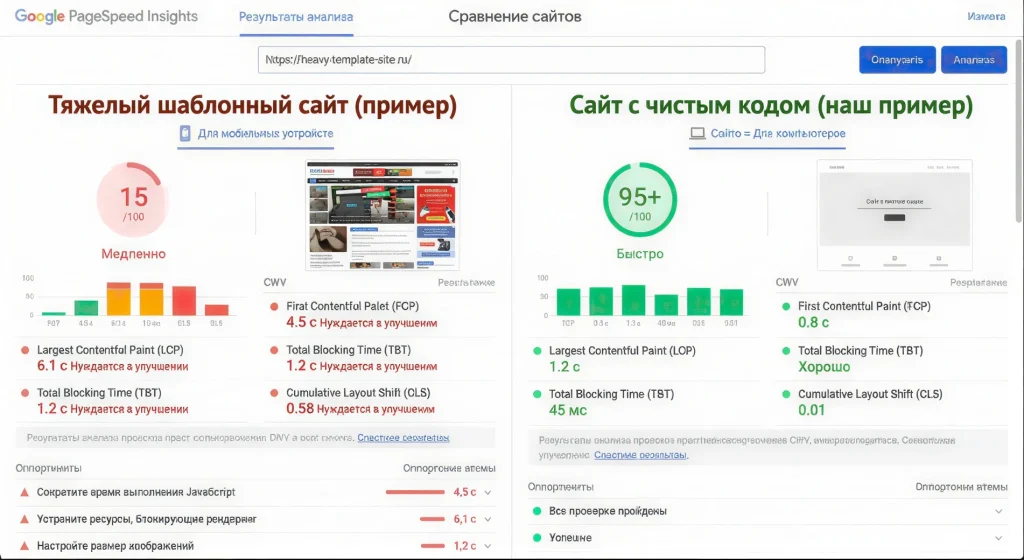
The answer lies in the concept of "technical debt." Cheap development is always like a credit card with astronomical interest rates. You save upfront, but pay for it in conversions every day. Ready-made templates (whether universal WordPress themes or cheap builds on website builders) are created with one goal in mind: to sell them to as many different companies as possible around the world.
The Anatomy of a Cheap Template: Why It Kills SEO
- Code Bloat. A universal template contains hundreds of scripts, styles, and functions, of which you'll need a maximum of 5%. But the user's browser is forced to download them all. As a result, the site weighs 10-15 megabytes. Given that a significant portion of your audience may be accessing your site via mobile internet outside of Tashkent, this heavy code means the page will take 7-10 seconds to load. Guess what the user will do after 4 seconds? That's right, they'll close the tab and go to a competitor. For Google, this is a "bad site" signal, and your SEO rankings will plummet.
- Security holes. Template-based websites often use pirated or hacked (nulled) plugins. Over 15 years of practice, I've saved dozens of businesses whose cheap websites were infected with hidden miners or redirected traffic to online casinos. Restoring your reputation in the eyes of search engines after such an infection takes months, during which time you lose money.
- Unable to scale. A template is a rigid box. As soon as your business grows and you need to implement a complex loyalty system, multi-level product filtering, or custom integration with 1C, you'll hit a wall. A programmer will have to rewrite the system's core, which is often more expensive than creating a new website from scratch.
Buying a cheap template in 2026 is like trying to build a multi-story business center on a cardboard foundation. Sooner or later, it will collapse under the weight of traffic.
Architecture and Tech Stack: The Foundation of Your Business
Understanding technology isn't just a bunch of programmers talking in an incomprehensible language. It's a strategic decision for a business owner. The technology stack you choose today will determine the cost of maintaining your website tomorrow.
Globally, the development market is divided into two areas: out-of-the-box solutions (CMS) and custom development (Frameworks). Let's examine them without unnecessary academic explanations.
Out-of-the-box solutions (CMS: WordPress, OpenCart)
These are content management systems where the basic functionality is already written. You don't build a house brick by brick; you buy a ready-made frame and renovate it.
- Who is it suitable for: B2B companies, service sector, medical clinics, corporate blogs, small e-commerce projects (up to 5,000 products) with basic sales logic.
- Specifics in 2026: In a professional environment, we no longer replicate other people's themes. We use the CMS solely as a convenient admin panel (back-end) for the client, while we write the visual part (front-end) from scratch (Custom Theme Development). This allows us to get the best of both worlds: the client gets a convenient and familiar admin panel for editing text, and we ensure perfectly clean code, lightning-fast loading speed, and 100% SEO compliance.
Custom development on Frameworks (React, Vue.js, Laravel, Node.js)
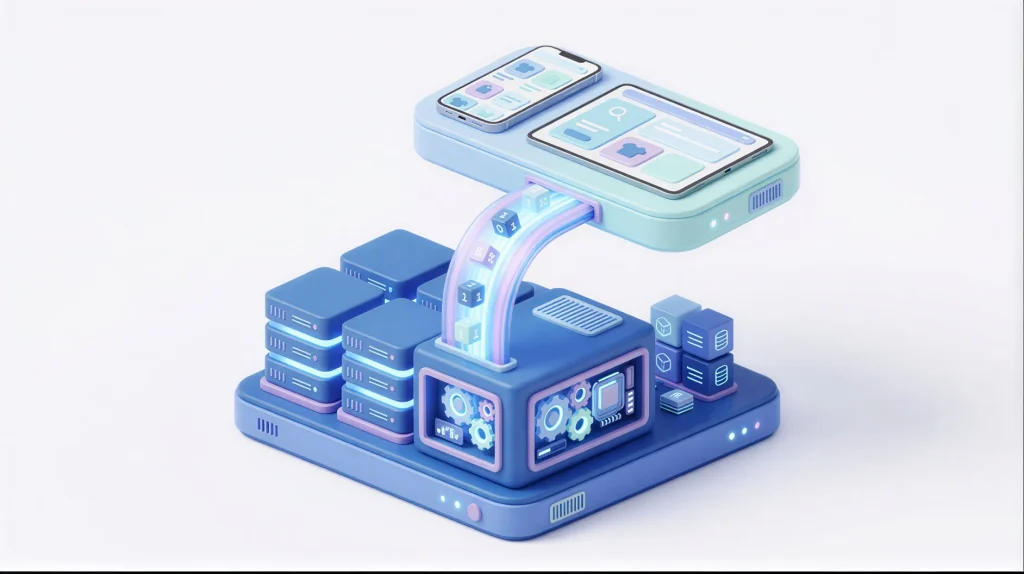
Here you create a system completely tailored to your business processes. No unnecessary details, just pure performance. In 2026, the standard for large businesses became Headless architecture (headless).
- The essence of Headless: The backend (how orders, inventory, and logic are processed) is completely separated from the frontend (what the user sees). They communicate with each other via a secure API bridge.
- Who is it suitable for: High-traffic projects, marketplaces, large online stores selling electronics and clothing, SaaS platforms, and services with personal accounts and complex loyalty programs.
- Why this is important: If you decide to launch a mobile app for iOS and Android tomorrow, you won't need to rewrite the logic. Your app will simply connect to the existing API of your Laravel backend. This is a huge cost savings over time. Furthermore, custom code can't be hacked through common vulnerabilities, as is the case with popular plugins.
UX/UI Design: Engineering the User Journey, Not Painting Pictures
One of the most destructive illusions in business is confusing design with art. When I audit low-converting websites, I often see "beautiful" interfaces overloaded with animation, flying elements, and unconventional fonts. The problem is, users don't need your creativity. They want to solve their problem as quickly as possible: find a product, check the price, and click "Buy.".
Professional UX/UI design in Uzbekistan in 2026 is based on rigorous analysis of target audience behavior patterns.
1. Mobile-First is not an option, it is the law
Google has switched the entire world to Mobile-First Indexing. The search robot is watching only to the mobile version of your website. If it's broken, the desktop version won't save you.
Considering that the share of mobile traffic in the consumer segment in Uzbekistan reaches 85-90%, we design interfaces based on the smartphone screen:
- Thumb Zone: All key conversion elements (add to cart, checkout, call) should be located in the bottom third of the screen. Users shouldn't have to grab their smartphone or reach for the upper left corner.
- Readability without zoom: The font size of the main text should be at least 16px, with high contrast for outdoor reading in the bright Tashkent sun.
2. Localization and trust patterns
The Uzbek market is unique, and blindly copying Western or Russian interfaces doesn't work here.
- Multilingual: The website must have flawless versions in Uzbek (Latin/Cyrillic) and Russian. Important: switching languages should not reset the cart or return the user to the home page.
- The "talk" factor: We live in a culture of direct communication. Even if your shopping cart is perfectly configured, a significant percentage of shoppers will want to clarify details with a live person. Convenient integrations with Telegram or a quick call option aren't just a button; they're a trust trigger that increases conversion rates.
3. Checkout (Order Placement): Risk Zone
The shopping cart is where businesses lose the most money. If you have five checkout steps that require users to enter their postal code, patronymic, and dog's name, you're handing customers over to your competitors.
- Killing forced registration: In 2026, no one wants to remember passwords. We're introducing seamless authentication via phone number (OTP password from SMS) or Telegram Login.
- Transparency: The cost of delivery in Tashkent or the regions should be obvious to Entering bank card details. Any hidden fees at the final step are a guaranteed cart abandonment.

The Nervous System of a Website: Mandatory Integrations (API)
A modern website can't exist in a vacuum. If orders from your website are still simply sent to your secretary's email, you're wasting valuable time and customer loyalty. In 2026, order processing speed will be your primary competitive advantage.
Turnkey development involves deep integration of the website with the business infrastructure:
Connecting payment gateways
To operate in the local market, direct integration with Payme, Click, Uzcard, and Humo. Programmers set up secure data exchange (API Webhooks) to ensure a smooth payment process:
- Generate a unique transaction ID.
- Automatically change the order status in the admin panel ("Awaiting payment" -> "Paid") without manual intervention.
- Setting up refund scenarios when an order is cancelled.
Synchronization with CRM systems (AmoCRM, Bitrix24)
The website should provide 100% of data to the sales department. With proper integration:
- The request instantly creates a lead or deal card in the desired CRM sales funnel.
- The manager sees not only the name and phone number, but also UTM tags: which ad the client came from, what keyword they used, and which pages they viewed before submitting the request.
- Two-way communication is implemented: if a manager in AmoCRM changes a deal's status to "Sent by courier," the client receives an SMS or Telegram notification with a tracking number.
Logistics and warehouse
For e-commerce, integration with warehouse systems (e.g., 1C) is critical to updating inventory in real time. If a customer pays for an item that's out of stock, you'll receive a negative response. Integration with logistics company APIs (Yandex Delivery, BTS, etc.) is also necessary to automatically calculate delivery costs based on the user's geographic coordinates.
SEO Foundation: Why We Lay It Before We Write Code
Most studios design, layout, program, deliver the project, and then the client comes to an SEO specialist asking for "website promotion." And that's where all hell breaks loose. It turns out the website's architecture is unsuitable for search engine optimization, thousands of duplicate pages are generated, and page loading speeds are at rock bottom.
As a Senior SEO expert I declare: Search engine optimization begins at the database design stage.
1. Architecture and structure of the directory
We design the structure based on the collected semantic core (real user queries). URLs should be static and clear. For online stores, we implement faceted navigation logic—the ability to create landing pages for low-frequency queries. For example, the intersection of the "Sneakers" category and the "White" filter should generate a separate page site.uz/shoes/sneakers/white, open to Google indexing, with a unique Title and H1 tag. This generates powerful organic traffic.
2. Schema.org data markup
To make your site stand out in search results with beautiful rich snippets, a programmer must implement dictionary code.
- Markup Product/Offer: Shows price, in stock status, and rating stars directly in Google search results.
- Markup Organization/LocalBusiness: tightly links your website to a physical address in Tashkent, helping with promotion on Google Maps.
3. Core Web Vitals (CWV) technical metrics
Google officially uses these metrics as a ranking factor. We provide:
- LCP (Largest Contentful Paint) < 2.5 seconds: The largest element on the first screen loads instantly. We achieve this through modern image formats (WebP), proper resource allocation (Preload), and server response optimization (TTFB).
- INP (Interaction to Next Paint) < 200 ms: The site responds instantly to clicks and taps, without freezing while JavaScript is running.
- CLS (Cumulative Layout Shift) < 0.1: Elements do not shift during loading, eliminating accidental clicks in the wrong place.

Estimate: What you're paying for and a detailed breakdown of pricing
Developing a professional website isn't a product purchase; it's a payment for the hours of work of a team of highly qualified engineers. Let's break down the cost to understand the true economics of the process. In 2026, the rates for experienced specialists (Middle+/Senior) in the Uzbekistan and CIS markets range from $20 to $40 per hour.
Typical team composition and time allocation for a high-quality corporate project:
- Project Manager (PM) and Analyst (5-15 hours): Gathering requirements, analyzing competitors, and writing specifications is enough time to establish a clear logic without turning the project into endless bureaucracy.
- UX/UI Designer (25–35 hours): We'll create responsive prototypes of key pages (home, catalog, product page, contact information) and develop a design system (UI kit). This will be enough to develop a high-quality, modern interface.
- Frontend Developer (25–40 hours): Layout based on mockups, adaptation for mobile devices, and basic optimization according to Web Vitals.
- Backend Developer (20-30 hours): Setting up CMS/admin panel, developing catalog logic, integration with CRM and payment systems (Payme/Click).
- QA Engineer / Tester (5–8 hours): Final testing of key scenarios (order placement, form functionality, cross-browser compatibility) before release.
- SEO Specialist (10–20 hours): Customizing the URL structure, meta tags, sitemap, and checking technical compliance with search engine requirements during the layout stage.
In total, professional development requires from 90 to 148 hours of team work.
Real price range on the Uzbek market (2026):
- Landing Page: $500 – $1 000. A well-developed tool with a marketing structure, high conversion rates, and basic Telegram/CRM integration. This isn't a template, but a custom design tailored to your niche.
- Corporate website (Business website / Service website): $1 000 – $2 000. A multi-page resource with a well-thought-out structure, a service catalog, a section for SEO articles, and mobile-friendly features. An ideal solution for construction companies, healthcare, or consulting.
- Online store (E-commerce): $2 000 – $4 500. A comprehensive product catalog, personal customer account, integration with payment systems (Payme, Click) and delivery services. Basic synchronization with accounting systems and a user-friendly admin panel for order management.
- Individual complex projects / Highload: from $5 000+. These include large marketplaces, systems with unique business logic, complex personal accounts with integrated CRM functionality, or systems with high workloads. The cost of such projects is calculated strictly based on the technical specifications (TS).
Why KelyanMedia: Expertise at the intersection of development and performance marketing
At KelyanMedia, we don't just write code. We build digital systems focused on your return on investment (ROI). Our approach is radically different from traditional web studios that hand you an archive of files and wish you luck.

- We think in metrics, not just aesthetics. Our primary criteria for a successful website are a reduced cost per lead (CPL) and an increased conversion rate (CR). The design is driven by sales logic.
- SEO-ready from the first second. As a Senior SEO, I personally oversee project architecture. You won't have to redesign your site six months later when you decide to launch organic promotion. All technical search engine requirements (from microdata to duplicate content removal) are implemented during the programming phase.
- Exceptional honesty in data. As our internal policy requires, we double-check every fact, every line of code, and every integration decision. We don't promise to build "Amazon in a week for $500," because we respect our work and your business.
- Seamless transfer to marketing. We're a full-service agency. Your website is designed so that our contextual advertising (Google Ads) and Telegram targeting specialists can drive hot traffic to it the day after launch and immediately receive clean data for end-to-end analytics.
Your website is your company's most important online asset. Build it strong with a team that understands how to turn pixels on your screen into real money in your bank account.